The core problem, stated plainly
Miscounts and expired stock share the same root cause more often than people realize: stock that isn't stored in one predictable place, rotated in a predictable order. Fix the layout and both problems shrink at the same time — they're not two separate battles.
Walk into a stockroom that's had six months of "just find somewhere to put it" deliveries, and you'll usually find the same product split across two or three spots, older stock buried behind newer stock, and a counting process that either takes forever or quietly misses things. This isn't a training issue. It's a physical layout issue, and it's genuinely fixable in an afternoon.
Why bad layout causes both problems, not just one
Miscounts happen when a product isn't in one predictable place. If your feta is split between the walk-in door and a shelf at the back because that's just where it landed on two different delivery days, a fast count either checks both spots (slower) or checks one and assumes that's everything (wrong).
Expired stock happens when older product gets buried behind newer product — almost always because the newer delivery was easier to shove in at the front than to properly rotate the older stock forward first. Nobody's being lazy on purpose; it's just faster in the moment, and the cost shows up weeks later when someone finds a forgotten tray at the back of the cold room.
Fix the layout so that both "where do I look" and "what's oldest" are obvious at a glance, and you've solved both problems with one change.
Five layout rules that actually work
1. One product, one zone — no exceptions
Every product gets exactly one home. Not "usually here, sometimes there depending on how busy the delivery day was." If a new delivery doesn't fit in that product's zone, that's a signal to rotate older stock out or reassess how much shelf space that line actually needs — not a reason to start a second pile somewhere else.
2. First-in-first-out, physically enforced
This is the classic rule everyone knows and almost nobody consistently follows under pressure. The fix isn't a sign that says "rotate stock" — it's a shelf layout that makes rotation the easy option, not the hard one. Front-loading shelves, where new stock physically has to go in behind old stock to reach its spot, make FIFO the path of least resistance instead of something staff have to remember to do against the grain of how the shelf is built.
3. Group by counting route, not just by category
Most stockrooms are organized by product type — all dairy together, all produce together — which makes sense for finding things but doesn't necessarily make sense for counting them fast. Lay out your fastest-moving, daily-counted lines along a single, short walking path, even if that means a slightly less "tidy" categorical grouping. The five-minute daily count depends on a route that doesn't zigzag the whole stockroom.
4. Make use-by dates visible without moving stock
If checking a use-by date means physically pulling a tray forward to see the label, staff will skip it when busy — which is exactly the moment it matters most. Store with the date-bearing end facing out, or use a consistent labelling spot, so a use-by check is a glance, not a lift-and-check.
5. Keep a note where the count happens, not somewhere else
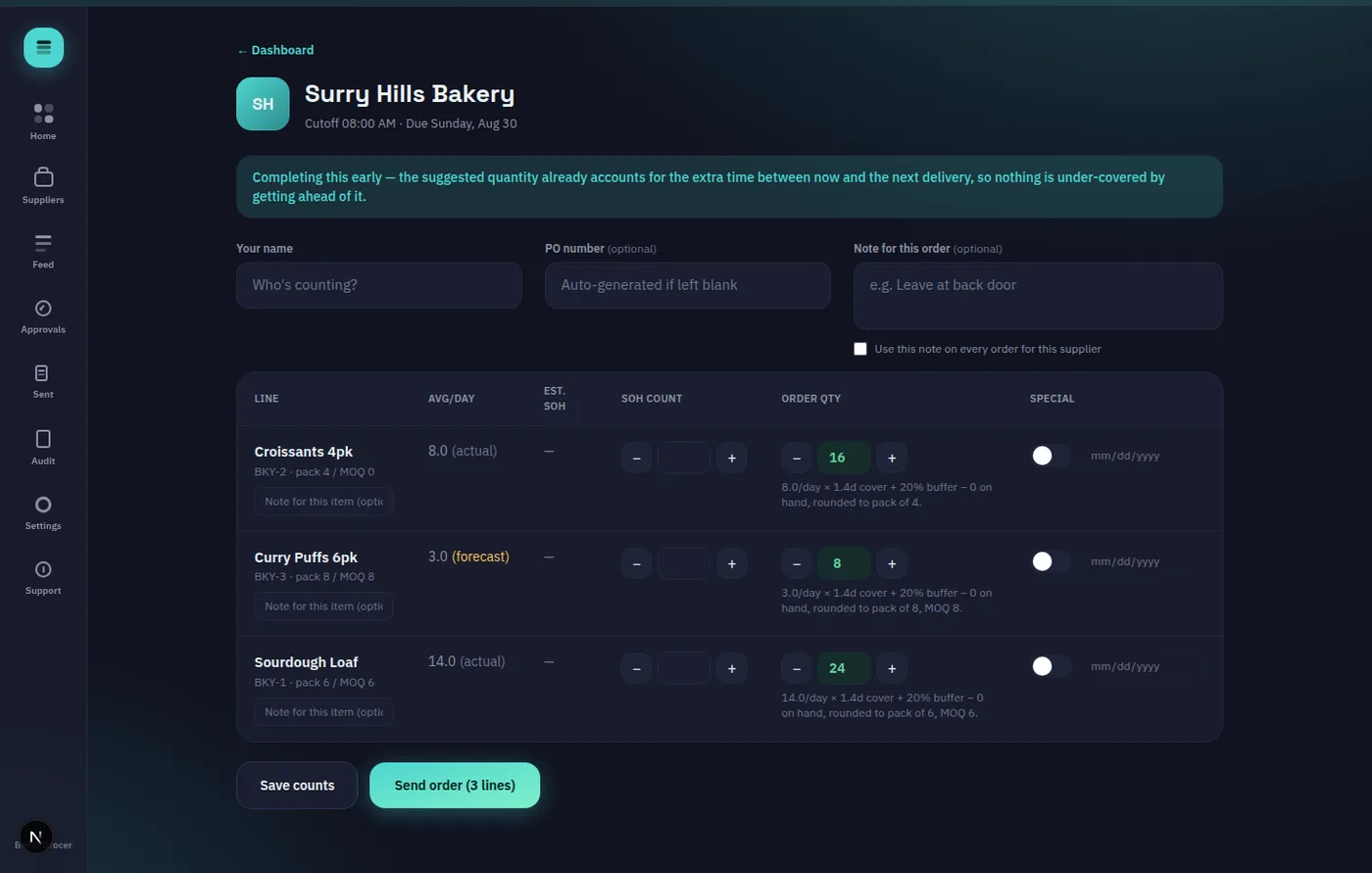
When you spot something during a stockroom walk — a tray close to its use-by, a delivery that needs checking before it's accepted — the note needs to live right there with that product's count, not on a separate whiteboard three rooms away that someone has to remember to check later. If your counting system supports a note per line item, right where the count itself happens, use it every time something looks off.
The connection between layout and accurate suggested orders
Here's the part that's easy to miss: a bad layout doesn't just cause visible waste, it quietly corrupts your ordering data too. If a count is wrong because half a product's stock was hiding behind another product, your recorded stock-on-hand is wrong — and any ordering suggestion built from that number inherits the error. A layout that makes counts fast and accurate isn't just about tidiness; it's what makes every downstream number in your ordering process actually trustworthy.
Worth doing once, properly
A full stockroom reorganization is a half-day job, maybe a full day for a larger store. It's also one of the few fixes that pays for itself almost immediately — less expired stock in the bin, faster counts, fewer "wait, didn't we already have some of this?" moments. If you're rebuilding your counting process at the same time, our knowledge base has a walkthrough of how daily counts and suggested orders connect, which is worth reading alongside any physical reorganization so the two reinforce each other rather than working against each other.
Get the layout right once, and the daily counting habit — and everything built on top of it — gets dramatically easier to sustain.