Two independent grocers can run the exact same stock-counting routine every week and end up with wildly different ordering accuracy — not because one counts more carefully, but because one of them is actually using each count to get smarter, and the other is starting from scratch every single time. That difference is worth naming directly: information gain, and it's one of the more underrated drivers of profitability in independent retail.
A stock count is not just a snapshot
At first glance, a stock count looks like a simple, isolated fact: there are twelve units of a product on the shelf right now. But a single count in isolation doesn't actually tell you much about what to order next — twelve units could mean the product is barely moving, or it could mean it's flying off the shelf and about to run out entirely. The number alone is close to meaningless without something to compare it against.
The real information is in the difference between two counts, adjusted for whatever stock arrived in between. If a shelf held twenty units a week ago, twelve were received since, and there are now eight left, the store sold roughly twenty-four units over that period — a real, measurable consumption rate. That's a genuinely useful number. And crucially, it's a number that only exists if the previous count was actually recorded somewhere and can be retrieved and compared, rather than discarded the moment the order was placed.
Why most independent stores never capture this
This is exactly where paper and memory-based ordering falls down structurally, not just inconveniently. A count written on a clipboard sheet, used once to place an order, and then thrown out or filed away unread, generates zero information gain — the exact same manual estimation has to happen again next week, from scratch, informed only by whatever the manager happens to remember. Over months and years, that adds up to an enormous amount of wasted signal: thousands of stock counts taken, and almost none of them ever actually used to refine anything.
It's a bit like re-reading the same page of a book every day and never turning to the next one. The information was there. It just never got carried forward into anything smarter.
What compounding information gain actually looks like
A system built to retain and use every count treats each new stock check as an update to an ongoing estimate of how fast a product sells, rather than a one-off task. Each count refines the picture a little further — a blend of the new observation and the prior estimate, weighted so recent reality has real influence without one unusual week throwing everything off. Over time, this produces an increasingly accurate, store-specific, product-specific sense of true demand — something no amount of manager intuition can match at the same level of granularity across dozens or hundreds of product lines simultaneously.
This is also where genuinely unusual readings matter. If a fresh count comes back wildly different from what the ongoing estimate expected — say, five times higher or a fifth as much — that's not just noise to smooth over; it's either a real shift worth confirming or a miscount worth double-checking before it's allowed to distort the model going forward. A well-designed system flags exactly that kind of outlier for a second look rather than blindly absorbing it, which protects the accuracy of the whole learning process from a single fat-fingered entry.
The profitability angle here is straightforward, even if it's rarely discussed in these terms: better information about actual demand directly reduces both of the costly ordering mistakes — over-ordering, which ties up cash and drives wastage, and under-ordering, which loses sales to empty shelves. A store that's been compounding accurate sales data for months genuinely orders better than a store re-guessing from scratch every cycle, even if the two stores are staffed by equally capable, equally hardworking people.
This compounding-accuracy principle is a core part of how OnHand's suggestion engine works — every stock count feeds directly into a refined estimate of average daily sales for that specific product at that specific store, visible right there on the 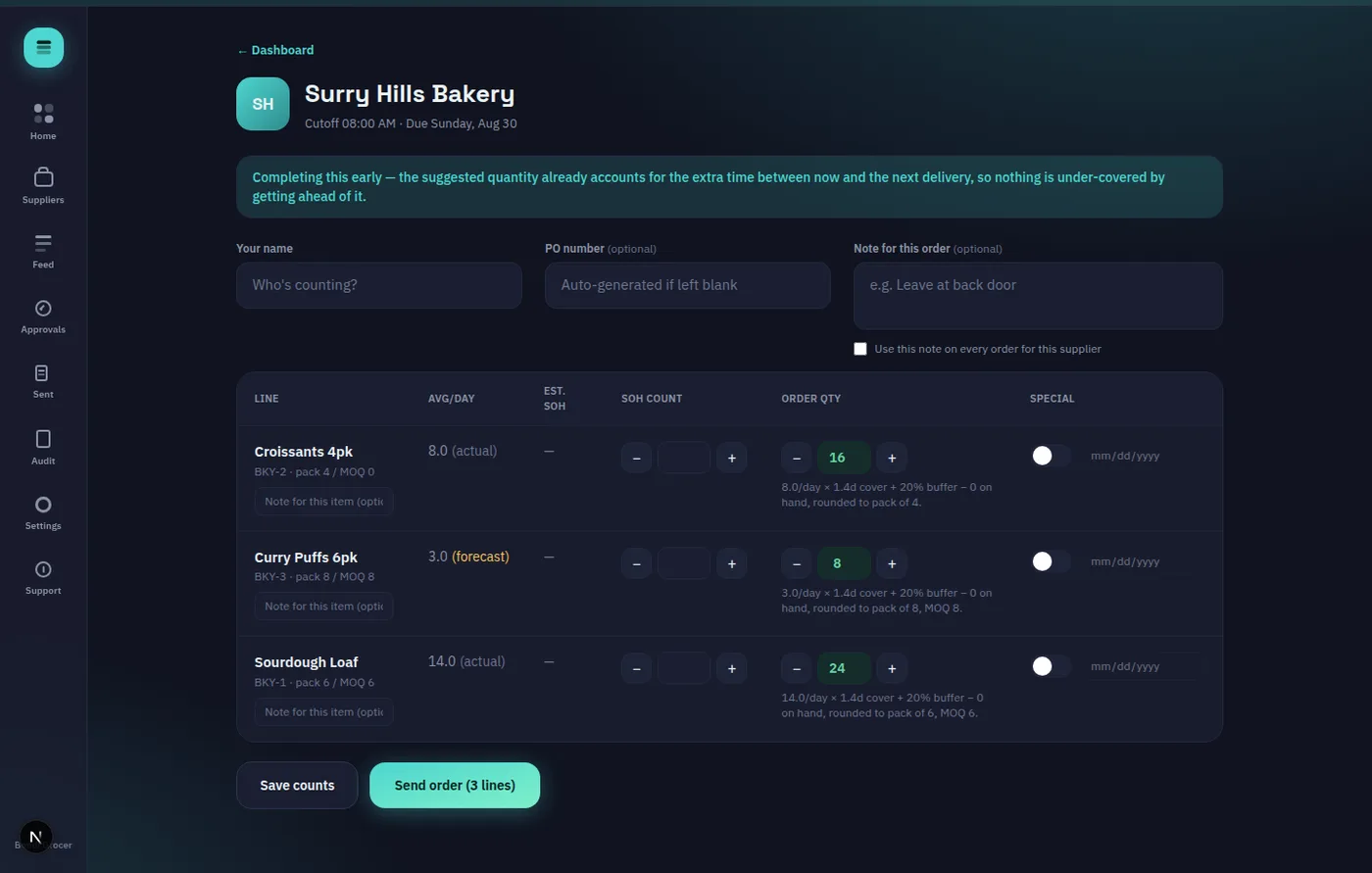 view as counts are entered. The full mechanics of how that works are covered in OnHand's knowledge base for anyone who wants the deeper detail.
Treat every count as an investment, not a chore
The habit of counting stock isn't going away — someone still has to physically look at what's on the shelf. But the value captured from that habit varies enormously depending on whether the information generated is retained and compounded, or discarded the moment the order goes out. Independent grocers chasing genuine profitability gains would do well to treat every single stock count not as a recurring chore to get through, but as a small, compounding investment in how accurately the store orders next time.