Ask an independent grocer how they know which supplier is due today, and the honest answer, more often than not, is a person — not a system. A manager who's been there for years, who carries the store's entire ordering rhythm in their head: which suppliers cut off when, roughly how fast each product line moves, which delivery came in short last month. That knowledge is real and valuable. It's also one of the most under-examined risks in the independent retail supply chain.
Memory as an unofficial system of record
Every business runs on some system for tracking what needs to happen and when. In a large chain, that system is software, deliberately built and maintained. In a huge number of independent stores, cafes and restaurants, the equivalent system is a person's memory, built up informally over months or years of doing the job. Nobody chose this as a deliberate strategy — it's simply what happens by default when there's no dedicated tool and a small team is stretched thin enough that documenting the process feels like a luxury.
The trouble is that a system built on memory has none of the properties a real system needs. It's not written down, so it can't be checked against reality. It's not shared, so it can't be handed off cleanly. And it's not consistent, because human memory doesn't hold steady under pressure — a hectic trading week, a staffing gap, or simply the accumulation of small details across dozens of suppliers all degrade recall in ways that are invisible until an order gets missed or an item runs out.
The failure mode nobody plans for
The obvious risk gets discussed occasionally — what happens if the one person who "knows how ordering works" leaves. But that's actually the less common failure mode. The more frequent, quieter one is drift: the manager is still there, still doing their best, but the mental model they're carrying has slowly gone slightly out of date. A supplier changed its cutoff time three months ago and the change never fully stuck. A new product line was added and nobody built an intuition yet for how fast it actually sells. A delivery day shifted for a public holiday and the adjustment was tracked mentally instead of anywhere durable.
None of these are dramatic failures. They're small, individually forgivable mistakes that, because they're never written down anywhere, never get corrected systematically either — they just recur, quietly costing the business a missed order here, an overstock there, indefinitely.
There's also a real staff-development cost to this pattern. If the store's actual operating knowledge lives entirely in one manager's head, no junior or casual team member can meaningfully take on ordering responsibility, because there's nothing for them to learn from except direct, repeated instruction. That bottlenecks the business around one person's availability in a way that's rarely discussed as a supply chain risk, but functionally is exactly that.
Turning tacit knowledge into a shared record
The fix for this isn't really about technology for its own sake — it's about converting knowledge that currently exists only in someone's memory into something explicit, checkable, and shareable. A supplier's cutoff time and delivery schedule, once entered into a system, stops depending on anyone remembering it correctly; it's just computed, the same way, every time, against the store's actual timezone and delivery calendar. A product's real sales rate, once tracked from actual stock counts over time, stops depending on someone's gut feeling about "how fast that usually moves" and becomes an observable number anyone can check.
This is also, quietly, what makes it possible to delegate ordering to more junior staff without it feeling risky. A system that shows what's due, what's at risk, and what the data suggests for an order quantity gives a less experienced team member the same situational awareness a longtime manager built up over years — while still leaving that final call, and the ability to override the suggested number, in a person's hands rather than an algorithm's.
An audit trail is a particularly underrated piece of this shift — every count, send, and approval kept as a real record rather than something that existed only in someone's recollection of "I'm pretty sure we ordered that." You can see what that looks like in practice in OnHand's own knowledge base, which documents the 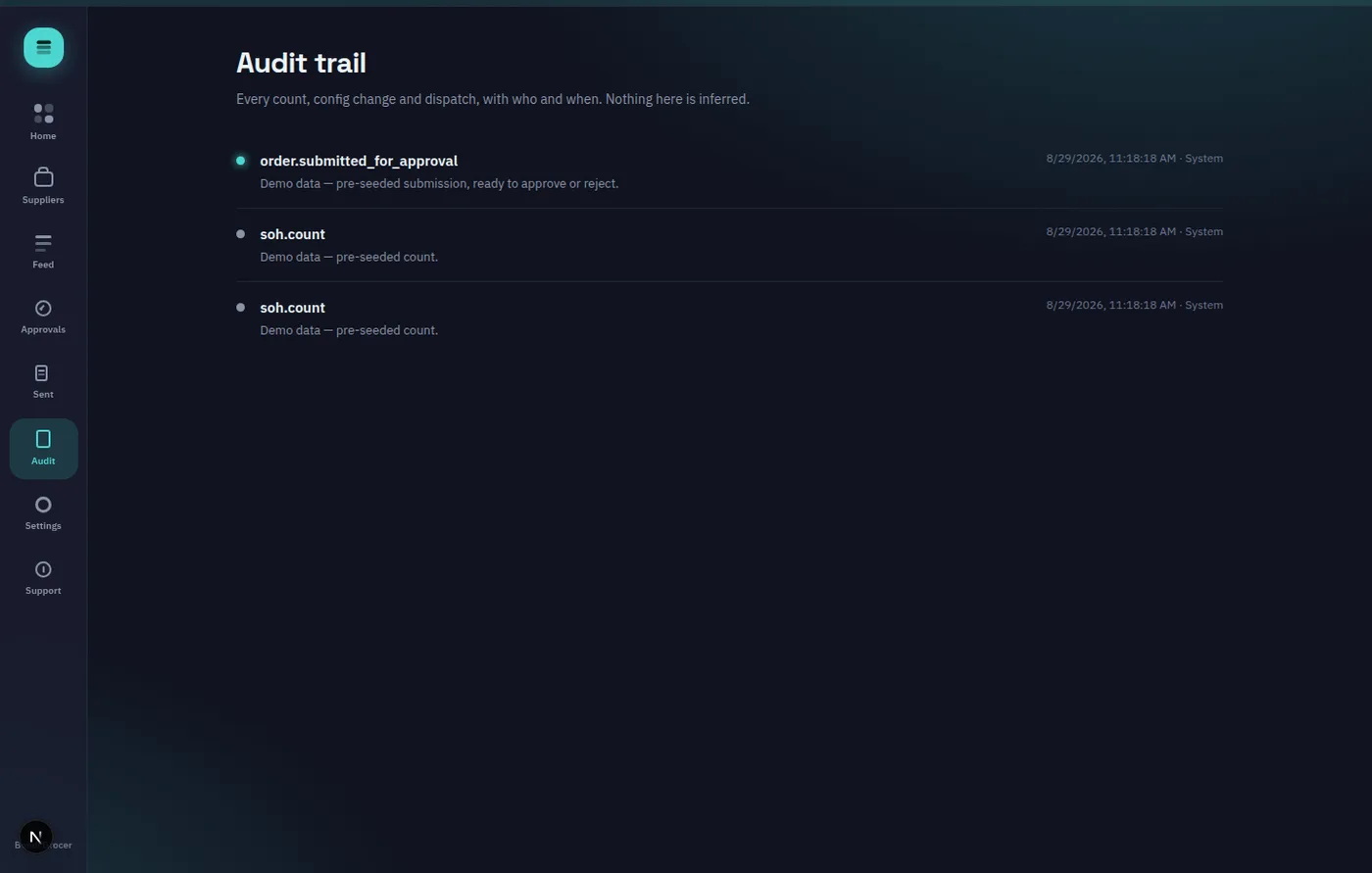 view alongside the rest of the day-to-day workflow it's built around.
Memory is not a strategy
None of this is a criticism of the managers who've run stores this way for years — it's what the tools available to them made possible, and they made it work through genuine skill and effort. But relying on memory as core infrastructure was never a deliberate choice so much as a default nobody replaced. As independent retail faces tighter margins and tighter staffing, that default is becoming one of the more obviously fixable risks in the whole operation — not because memory is unreliable in some abstract sense, but because a business shouldn't have to bet its supply chain on nobody having a bad week.