The short version
Price increases and invoice errors slip through when nobody's checking line items against what was actually agreed — they get caught by checking the total against a rough memory of "that feels about right," which almost never catches anything. Fix the checking, not the supplier relationship.
Every store manager has had this moment: an invoice lands, the total looks roughly normal, you sign off, and three weeks later you notice your cheese line has been running 9% higher for a month and nobody flagged it. It's not dishonesty on the supplier's side, usually — reps update price lists, systems don't always sync, and a genuine increase can land on an invoice before anyone tells you it's coming. The problem is the gap between "invoice arrived" and "someone actually checked it line by line."
Why this keeps happening even to careful stores
Three things conspire against catching this in the moment:
Volume. A busy grocery or café is processing dozens of line items a week across multiple suppliers. Checking every single one against a remembered price is genuinely hard to sustain.
Timing. Invoices often arrive during your busiest hours — mid-morning delivery, mid-shift chaos — exactly when a careful line-by-line check is least likely to happen.
No baseline. If you don't have a written record of what you agreed to pay per unit, you've got nothing concrete to check the invoice against. You're comparing a number to a feeling, and feelings drift.
A process that actually catches this
1. Keep a real record of agreed prices, per supplier, per line
This doesn't need to be fancy — even a simple running note of "current agreed price per kg/unit" per supplier line is enough, as long as it's updated the moment a price change is actually confirmed, not left stale for months. The point is having something concrete to check an invoice against, rather than relying on memory.
2. Check invoices against the order, not against the total
The total on an invoice can look "about right" even when one line item has jumped 15% and another has quietly dropped — they can offset each other and still leave you paying more than you should be, with the error invisible at a glance. Check line by line, or at minimum spot-check your highest-volume and highest-cost lines every single delivery.
3. Flag discrepancies at the line level, immediately, in writing
The moment you notice a mismatch — price higher than agreed, quantity different from what was ordered, a substitution nobody mentioned — note it against that specific line right then, while the delivery's in front of you and the context is fresh. A note like "invoiced at $14.20/kg, agreed $12.80 — confirm with rep" attached directly to that line beats a mental note you'll try to reconstruct at end of day.
4. Use your own order as the reference point when you call the rep
When you follow up with a supplier about a price discrepancy, having your own record of exactly what was ordered — quantities, any notes, the PO number if you use one — makes the conversation faster and harder to argue with. "Your invoice says X, my order says Y" is a much stronger position than "I think this seems higher than usual."
A manual PO number on each order, one you set yourself rather than relying on whatever the supplier's system generates, makes this kind of paper trail easier to keep straight across multiple suppliers and multiple weeks.
5. Keep the trail, not just the resolution
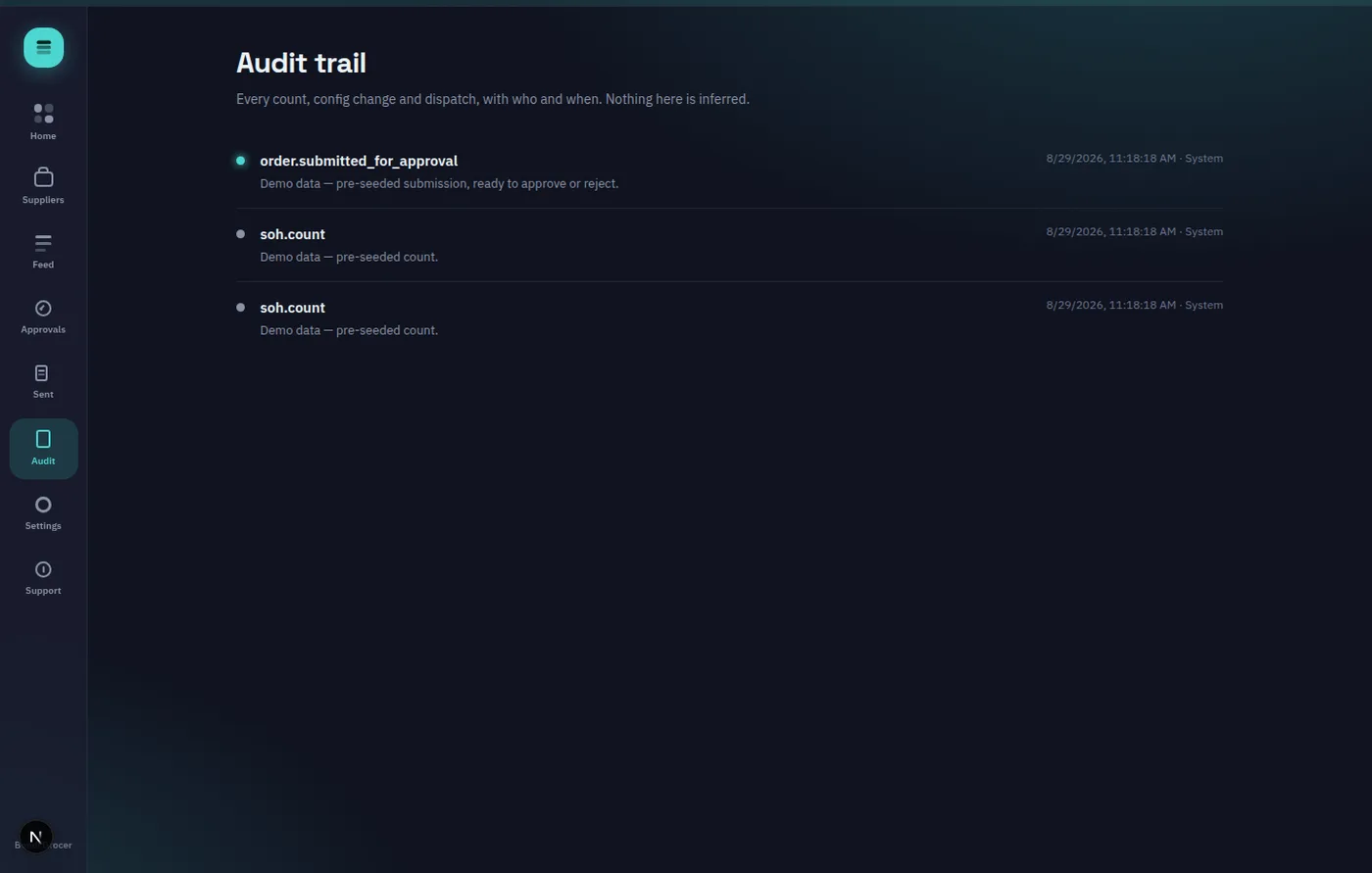
Once a discrepancy is sorted, the temptation is to just move on. Worth resisting — a running record of what happened and when (an audit trail, effectively) is what turns "this feels like it happens a lot with this supplier" into "this has happened four times in six weeks, here's the dates and amounts" — a much stronger conversation to have with a rep or, if it keeps happening, with whoever above them handles account issues.
When a real price increase is coming, not just an error
Sometimes it's not a mistake — commodity prices genuinely move, and a supplier is entitled to pass that on. The difference is whether you were told in advance. A supplier who quietly raises prices on the invoice with no warning is a different conversation than one who calls ahead to flag a genuine market shift. Keep track of which is which per supplier; it's useful information the next time you're deciding who to give your volume to.
Making this less manual over time
The underlying fix for all of this is the same one that fixes most stockroom headaches: get the agreed numbers, the actual order, and the delivery record sitting in the same place instead of scattered across a notepad, a memory, and an invoice. If your ordering process already tracks per-line notes and a full history of what was sent and when, catching a discrepancy becomes a five-second comparison instead of a memory exercise. Our knowledge base covers how per-line notes and order history work end to end if you want to see the mechanics.
A single missed price increase is a rounding error. A pattern of them, uncaught for months, is real margin walking out the door — worth the five extra minutes it takes to check.