The short answer
Delegating ordering safely means giving staff a calculated number to start from, clear limits on where they can deviate without asking, and a manager sign-off step reserved only for your highest-stakes suppliers — not a hands-off free-for-all, and not a bottleneck where every single order needs your personal approval either.
Most managers avoid delegating ordering for one honest reason: the first time they handed it off, someone over-ordered a perishable line and it went straight in the bin, or under-ordered ahead of a busy weekend and the shelf went bare. That one bad experience is enough to make anyone go back to doing it all personally — which doesn't scale, and burns you out.
The actual fix isn't avoiding delegation. It's delegating with the right structure underneath it.
What "safe delegation" actually requires
1. Nobody should be ordering from a blank field
The single biggest risk in delegated ordering is a staff member facing an empty number field with nothing to reference except their own nerve. That's where wild over- or under-ordering comes from — not laziness, just genuine uncertainty with nothing solid to anchor to.
Give them a calculated starting number instead — based on actual recent sales for that line, the real gap until the next delivery, and a sensible pack-size rounding — and their job shifts from "guess a number" to "review a number and adjust only if something's genuinely different this week." That's a fundamentally lower-risk task, and one most staff pick up quickly.
2. Reserve real sign-off for the orders that actually matter
Not every supplier carries the same risk. Your weekly bread order and your fortnightly meat order aren't the same stakes — a mistake on one costs a few dollars, a mistake on the other can cost hundreds. A lightweight manager approval step (a PIN, checked fresh each time, no separate login to manage) on just your highest-cost or highest-risk suppliers gives you a real checkpoint where it matters, while routine orders send straight through without anyone waiting on you.
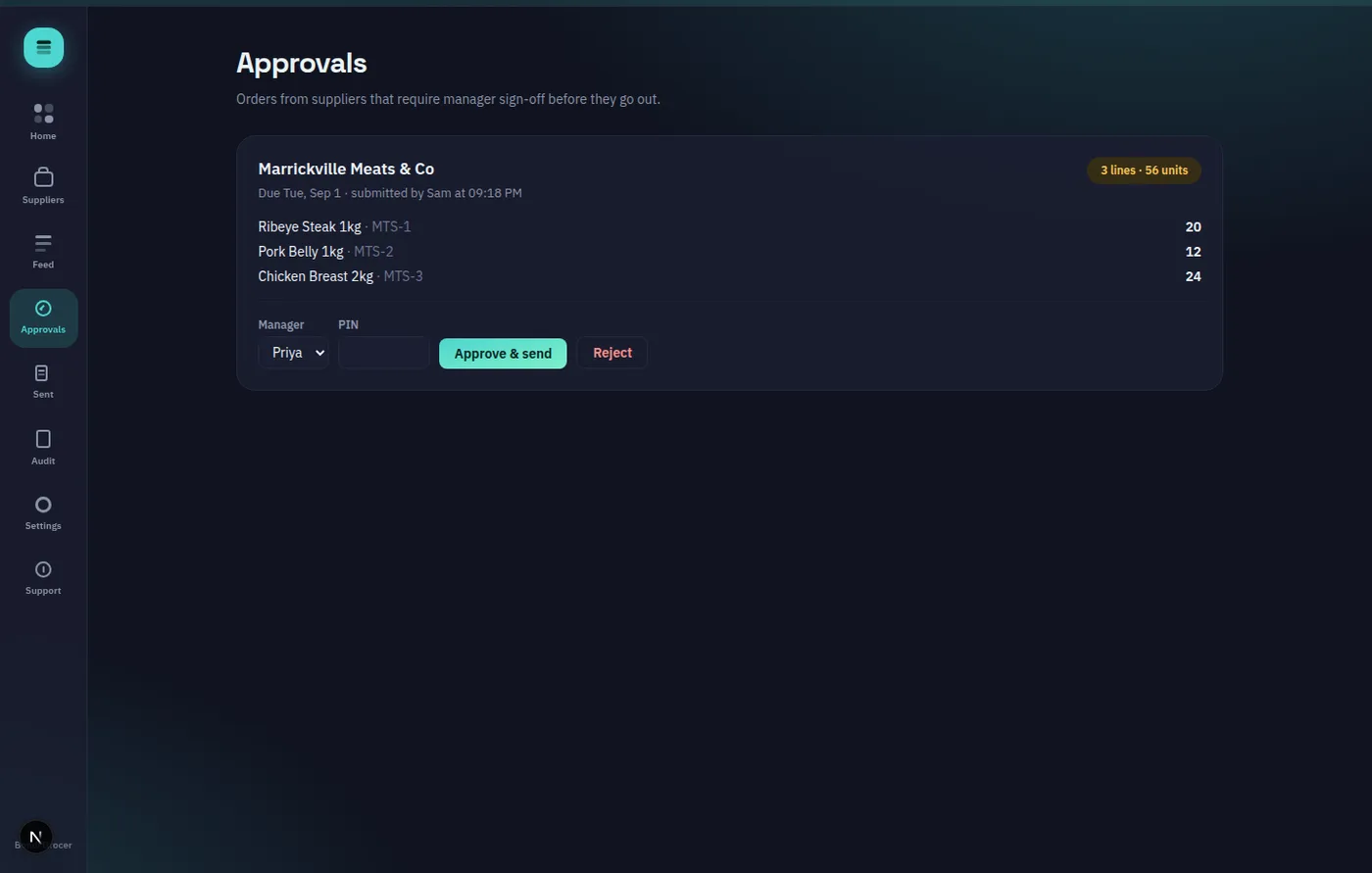
This is the difference between genuine oversight and either full micromanagement (approving everything, which defeats the point of delegating at all) or full hands-off risk (approving nothing, which is how the bad experience happened in the first place).
3. Make notes part of the handoff, not a separate conversation
If a staff member notices something worth flagging while counting — a delivery that needs checking, a tray close to its use-by — that note should travel with the order itself, not get relayed verbally later (or forgotten). A note attached directly to the relevant line, visible to whoever reviews or receives the order, keeps context from getting lost in the handoff between counting and sending.
4. Keep a real record of who did what
Delegation works better when it's visible, not invisible. A full history of who counted, who sent, who approved — and when — isn't about catching people out. It's what lets you spot a genuine pattern (someone consistently padding a particular line, say) early, have a specific, evidence-based conversation about it, and course-correct before it becomes a habit rather than a one-off.
5. Start with your lowest-risk supplier, not your highest
If you're new to delegating this at all, don't hand over your most expensive, most complicated supplier first. Start with something routine and forgiving — dry goods, packaging — let staff build confidence and you build trust in the process, then expand to your higher-stakes suppliers once the pattern's proven itself.
6. Set expectations about silence, not just about action
Part of what makes delegation feel safe for a manager is knowing they won't get pinged for every single order that goes through fine. A system that only surfaces a warning when something's genuinely at-risk or missed — and stays quiet the rest of the time — means you can hand off routine ordering without either babysitting it or losing visibility entirely. If every completed order or every routine send generates a notification, the important ones get lost in the noise within a week, and people start ignoring the channel altogether. Silence on the routine stuff is what makes the alerts on the stuff that matters actually get noticed.
What this looks like once it's actually working
A well-delegated ordering process means you're not the bottleneck for routine orders, you've got a real checkpoint on the ones that carry real risk, and you can see exactly what happened and why without having to ask anyone to remember. That's a genuinely different position than either doing every order yourself or handing it off and hoping for the best.
If you're weighing what this actually looks like day to day, the live demo walks through a real order from count to suggested quantity to send, with no signup — including what an approval step looks like from the manager's side. The full mechanics of setting up per-supplier approval and PIN sign-off are covered in our knowledge base, and if over-ordering specifically is your current sticking point rather than the delegation itself, our other piece on why junior staff over-order perishables digs into the psychology behind it.
Delegation isn't the risk. Delegating with nothing to guide the decision is the risk — fix that, and handing off ordering stops being something you dread.