The real reason, stated plainly
Junior staff over-order because guessing wrong in the direction of "too much" feels safe and guessing wrong in the direction of "too little" feels like a visible failure — an empty shelf in front of a customer. Nobody's ever handed them a defensible number to start from instead of a guess, so they pad it.
Walk into most stockrooms after a new hire's first solo order and you'll find the pattern: bananas ordered for a week when they turn in four days, extra trays of mince nobody asked for, a second case of milk "just in case." It's rarely laziness. It's risk management by someone who doesn't yet have the pattern-recognition an experienced manager built up over years of watching the same shelves empty and fill.
Why lecturing about waste doesn't fix it
Telling a junior team member to "just order less" doesn't give them anything to actually do differently next Tuesday. They still don't know how much less, on which lines, and they're still facing the same underlying fear: an empty shelf on a Saturday with their name on the order sheet. Without a replacement for the guess, the guess just gets slightly more nervous — which, if anything, sometimes pushes the padding up rather than down.
The actual fix isn't a talking-to. It's giving them a number that's based on something real, that they can see and adjust, instead of a blank field they have to fill from nerve alone.
Three things that actually reduce over-ordering
1. Show the maths, don't just show a number
If a junior staff member sees "order 40" with no context, they don't know whether that's conservative or already padded — so they might pad it further, just in case the number's wrong too. If instead they see "you're averaging 6.2kg a day, you've got 3 days until the next delivery, here's 3kg on hand already, so the shortfall is 15.6kg" — that's something they can actually reason about and adjust with real information, rather than override on a hunch.
This is exactly why OnHand's suggested order quantity is deterministic, plain arithmetic — average daily sales times the days until the next delivery, plus a small buffer, never an opaque AI guess — and it's shown as a starting number a person reviews and can change, never something that auto-sends. A junior team member overriding a transparent number they understand is a completely different, healthier habit than a junior team member inventing a number from scratch because the field was blank.
2. Separate the panic lines from the routine ones
Some lines genuinely are worth a bit of extra buffer — a fast-selling weekend special, a line that's historically unpredictable. Most lines aren't. If every line gets treated with the same "better safe than sorry" logic, the safety margin compounds across dozens of products and turns into real weekly waste.
Have an honest conversation about which specific lines are worth erring generous on, and which ones have been stable and predictable enough that the suggested number should just be trusted as-is. This turns "always order a bit more" into "order a bit more only where it's actually warranted" — a much smaller, much cheaper habit.
3. Put a second set of eyes on the orders that matter most
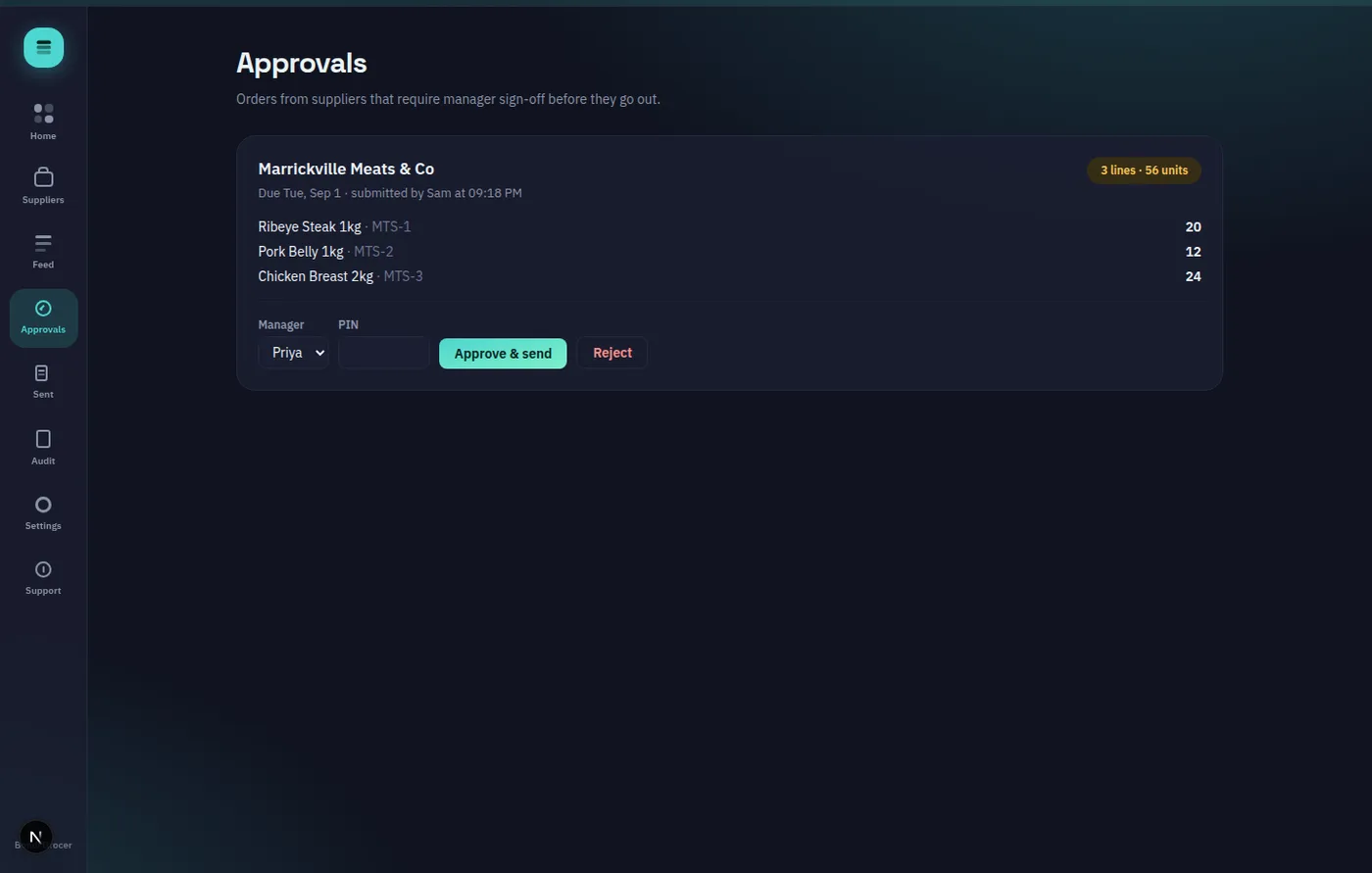
You don't need to check every order a junior staff member places — that's the micromanaging you're trying to avoid. But for your highest-cost or highest-risk suppliers (the weekly meat order, say), a lightweight manager sign-off before it goes out catches the outliers without slowing down the routine bread order.
This is a genuinely different thing from watching over someone's shoulder all day — it's a spot-check on the orders where a mistake actually costs real money, applied consistently rather than randomly. OnHand supports this as a per-supplier toggle: require a quick manager PIN approval before certain suppliers' orders go out, while routine ones send straight through with no extra step.
What this looks like once it's working
A junior staff member should, within a few weeks, start trusting the suggested number as their default and only nudge it up or down for a genuine reason they can name — "we've got a function Saturday" or "this line's been slow this week" — rather than padding everything by habit because they're not sure. That's the actual goal: not zero adjustments, but reasoned adjustments instead of anxious ones.
If you want to see what a transparent, explainable suggested-order screen actually looks like before rolling it out to your team, the live demo lets you walk through a real count and suggestion with no signup. And if you're specifically weighing how to hand ordering to newer staff without losing control of it, our piece on delegating wholesale ordering to floor staff safely covers the approval and oversight side in more depth.
Over-ordering isn't a character flaw in your junior staff — it's what happens when nobody gives them anything better than a guess.