Supply chains for independent grocers have never been perfectly predictable, but the last several years have made the unpredictability itself a permanent planning consideration rather than an occasional disruption to work around. Lead times shift. A line that was reliably available for years suddenly isn't. A supplier changes a delivery day with little notice. Independent supermarkets are adapting less by predicting volatility and more by building ordering processes flexible enough to absorb it without falling apart.
Why volatility hits independent operators differently
Large supermarket chains have tools available to absorb supply chain disruption that independent operators generally don't: bulk purchasing leverage, dedicated supply chain and logistics staff, and enough scale to diversify across multiple suppliers for the same product category. An independent grocer typically has none of that cushioning. A single supplier having a bad week can directly translate into an empty shelf, with no backup buffer of scale to soften the impact.
That asymmetry means the sensible response for an independent operator looks different from a large chain's response. Trying to out-negotiate or out-stockpile volatility isn't realistic at independent scale. What is realistic is making the ordering process itself more accurate and more responsive, so that when conditions do shift, the store notices and adapts quickly rather than continuing to order on autopilot against assumptions that are no longer true.
The habit trap volatility exposes
A lot of independent ordering has traditionally run on a simple heuristic: order roughly what was ordered last time, adjusted a little by feel. That approach is forgivable in a stable supply environment, where "roughly the same as last time" is usually close enough to correct. It breaks down badly under volatility, because it has no mechanism for reacting to a changed lead time, a partial delivery, or a supplier substitution — it just keeps repeating the old pattern until someone notices something's gone wrong, usually after the fact.
This is where the gap between habit-based and data-based ordering becomes most visible. An ordering process anchored to actual, current stock counts and real observed sales rates naturally adjusts as conditions change — a delayed delivery shows up directly as lower-than-expected stock on the next count, and the suggested order quantity for the following cycle reflects that reality automatically, without anyone needing to consciously remember "oh, that delivery was short last time, better order more."
Visibility into what's already in transit matters more now
One specific piece of this has become more important as volatility has increased: knowing what's already been ordered and is on its way, especially when a store is ordering from the same supplier again before the previous order has fully arrived. A fast-moving line, or an order placed slightly ahead of schedule, can easily overlap with stock that's already incoming — and a naive process that doesn't account for that risks suggesting the same shortfall be ordered twice, compounding into real overstock once both orders land.
A more sophisticated approach credits that pending incoming stock directly against the next suggested order quantity, factoring in only what's genuinely expected to have arrived by the time the new order's own cover period runs out. It's a small piece of arithmetic, but in a volatile supply environment where orders overlap more often than they used to, getting it right prevents a real and recurring source of over-ordering.
What this looks like as a stocking strategy
The independent supermarkets navigating volatility most comfortably right now tend to share a pattern: they've moved away from treating each order as a repeat of the last one, and toward treating each order as a fresh calculation grounded in current, real conditions — actual stock on hand, actual recent sales rate, and actual visibility into what's already incoming. None of that eliminates volatility, but it means the store's response to volatility is fast and accurate rather than delayed and reactive.
This is the specific problem OnHand's suggested order quantity is built to address — combining current stock counts, an ongoing sales-rate estimate, and pending incoming orders into one number a manager reviews and can adjust before anything is sent, visible on the OnHand suppliers overview alongside per-supplier 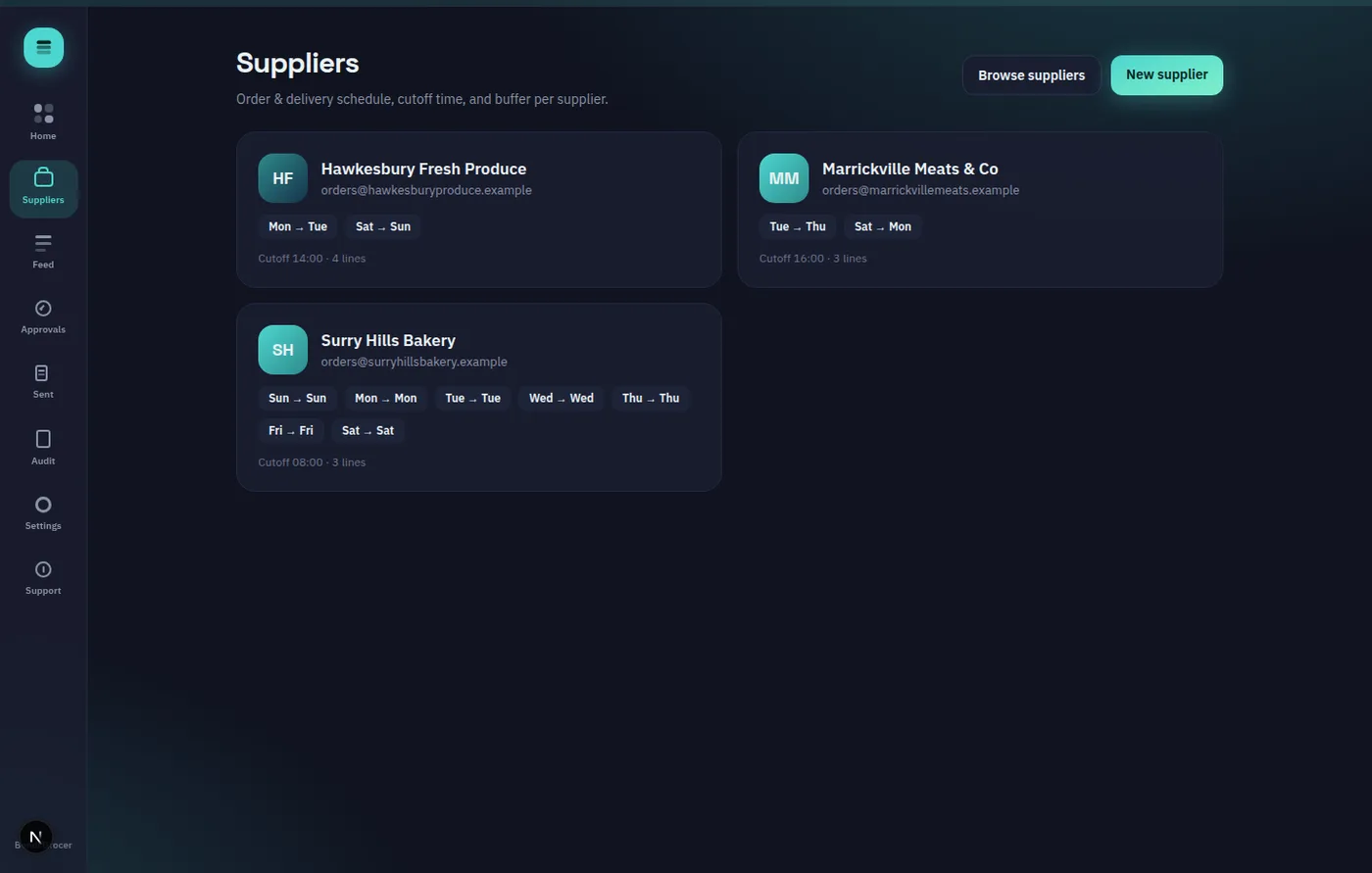 management for stores juggling more than a handful of relationships.
Volatility as the new normal, not the exception
The independent grocers adjusting best to a less predictable supply environment aren't the ones with some special insight into what's coming next — nobody has that. They're the ones who've built an ordering process responsive enough that it doesn't need to predict volatility in advance, because it reacts accurately to real conditions the moment they change. That's a more durable strategy than trying to guess right, and it's increasingly the direction the more resilient independent operators are heading.