Neither SMS nor email is categorically better for a supplier ordering workflow — they solve different problems, and the human-error question isn't "which channel" but "which channel for which job." SMS is well suited to fast, time-sensitive approval requests a manager needs to see immediately; email is well suited to the order itself, where a durable, searchable, attachment-friendly record matters more than speed. Used for the wrong job, either one introduces its own error risk.
This is worth untangling carefully, because "SMS vs. email" as a framing can make it sound like a single either/or choice, when in a well-designed ordering workflow, they're typically not competing at all — they're doing different jobs at different points in the same process.
What each channel is actually good at
Email's strengths:
- Durable record that both sides can search later
- Supports attachments — a formatted order PDF a supplier's team can print or file
- Not time-pressured — a supplier can process it whenever their team gets to it
- Familiar dispute-resolution trail ("here's exactly what was sent, and when")
Email's weaknesses:
- Easy to miss or bury in a crowded inbox, especially for a time-sensitive internal approval request
- No inherent urgency signal — an approval-request email can sit unread for hours
SMS's strengths:
- Near-immediate visibility — most people check a text within minutes
- Well suited to interrupt-worthy events: an at-risk order, a critical alert, an approval request
- Short and hard to skim past, unlike a long email
SMS's weaknesses:
- Poor fit for anything requiring detail — a full order with line items and notes doesn't belong in a text
- No attachment support in most implementations
- Can become noise if overused for non-urgent updates, training people to ignore it (the same "alert fatigue" problem any channel has if it fires too often)
Where human error actually creeps in
The real error patterns worth designing against are specific:
- An order goes out with a quantity nobody double-checked, because there was no natural point in the process where a second person looked at it.
- A time-sensitive approval sits unnoticed, because it arrived in a channel the approver doesn't check quickly (a manager who doesn't live in their inbox but does check texts).
- The order itself gets sent through a channel with no record, making a later dispute ("we never received that delivery instruction") hard to resolve.
- Notification fatigue causes a real alert to get ignored, because too many low-stakes notifications trained the recipient to skim past all of them.
Matched against these, the right design isn't "pick one channel" — it's use each channel for the failure mode it actually prevents.
A workflow that uses both, for what each is good at
A sensible combination looks like this: routine orders flow through automatically once counted and sent, with the order itself going to the supplier by email (or SMS as a supplement, for suppliers whose real ordering channel is a text to a sales rep rather than an inbox — some genuinely operate that way). For specific suppliers where a mistake is costly — the big weekly meat order, say — a manager approval step is required before it sends, with an SMS notification the moment approval is needed, since that's the one message in the whole cycle that's genuinely time-sensitive and worth interrupting someone for.
OnHand's approval workflow works this way: Supplier.requiresApproval is a per-supplier toggle, not a store-wide one, so most orders keep flowing at normal speed while the specific ones worth a second look get a lightweight PIN-based sign-off. SMS and email alerts are both optional, and — importantly — silent by default: only at-risk, critical, or missed-order states trigger a notification at all, which is precisely the design choice that keeps either channel from becoming noise a manager learns to ignore.
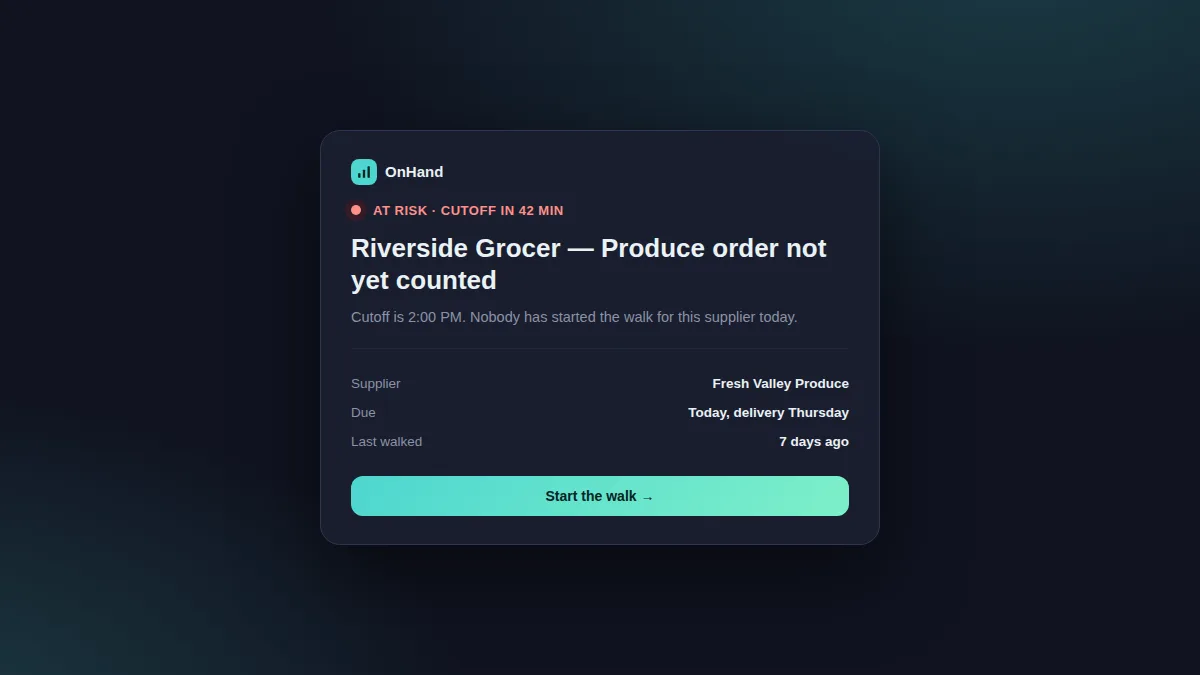
The honest tradeoff of adding an approval step at all
Any approval layer, on any channel, trades a small amount of speed for a reduction in error risk. For a store with tight margins on a handful of expensive supplier relationships, that trade is usually worth it. For a store where every order is low-stakes and low-value, an approval step anywhere in the pipeline may just be friction with no real payoff — worth applying selectively, per supplier, rather than uniformly.
Evaluating this for your own store
Look at your actual order history and ask which suppliers, if a wrong quantity went out, would genuinely cost you — those are the candidates for an approval step, not every supplier by default. If you want to see a real implementation of the selective-approval-plus-silent-alerting model described above, try the approval queue yourself — it's a real, working flow with no account required.