For a long time, ordering stock in an independent grocery or hospitality venue has been treated as an owner-or-senior-manager task by default — not because junior staff couldn't physically do it, but because getting it wrong carries real financial consequences, and there was rarely a good mechanism for delegating the work without also delegating unchecked risk. That's beginning to change, and it's changing because the tools around delegation have gotten meaningfully better, not because owners have suddenly become more trusting.
The old all-or-nothing choice
Historically, delegating inventory ordering has been close to a binary decision. Either the owner or a senior manager places every order personally, which keeps things accurate but creates a real bottleneck — nothing gets ordered if that one person is unavailable, on leave, or simply stretched too thin across everything else running a small business demands. Or ordering gets handed to junior staff with minimal oversight, which frees up the owner's time but introduces real risk: a miscounted stock level, a misunderstood supplier cutoff, or a quantity typo can directly cost money, and there's often no mechanism to catch it before the order goes out.
Neither option is particularly good, and most independent operators have simply lived with whichever one felt less risky, usually the first. That's a rational response to the tools that were available — but it's also a real constraint on how a small business can grow and staff itself.
What actually enables safer delegation
The shift happening now isn't about owners becoming more willing to take on risk. It's about better systems narrowing the gap between "fully supervised" and "fully unsupervised" into something in between — delegated, but with real guardrails.
A few specific mechanisms make this possible. First, a clear, current view of what's due and what's at risk removes the need for a junior staff member to hold an entire supplier schedule in their head — the system tells them what needs attention today, rather than relying on their memory of a pattern they may not have fully learned yet. Second, a data-grounded suggested order quantity gives a less experienced team member a sensible starting point instead of a blank field to guess into, while still leaving room for them to adjust it based on something the data can't see, like a promotion or an unusual event coming up. Third, and most directly, an optional approval step — scoped to specific suppliers rather than applied blanket-wide — lets an owner keep a check on the orders that genuinely carry more risk, like an expensive meat order, while letting the routine, low-stakes orders go straight out without waiting on anyone.
That last piece matters because it avoids the trap of an all-or-nothing approval policy. Requiring every single order to be approved just recreates the original bottleneck in a slightly different shape. Requiring none of them recreates the original risk. A narrow, targeted approval step — applied only where it's actually worth a second pair of eyes — is what makes real delegation practical rather than theoretical.
Ownership, not just task assignment
There's a meaningful difference between handing someone a task and giving them genuine ownership of it, and the systems enabling this shift are what make the second one possible. A junior staff member who can see exactly what's due, understand why a suggested quantity looks the way it does, and know that a manager will review anything genuinely high-stakes, is in a fundamentally different position than one who's just been told "place the bread order" with no context and no safety net. The former can grow into the role. The latter is just executing instructions.
This also changes what an owner's oversight actually looks like day to day. Instead of personally placing every order, an owner's real role shifts toward reviewing a record — who counted what, what was approved, what went out — which, done well, gives more genuine visibility into the business than manually placing every order ever did, because it's a complete, structured history rather than whatever the owner happened to remember doing.
This is close to the exact shape of the manager-PIN approval workflow inside OnHand — scoped per supplier, not store-wide, so an owner can delegate the routine ordering entirely while still gating the orders worth a second look, all visible through the same 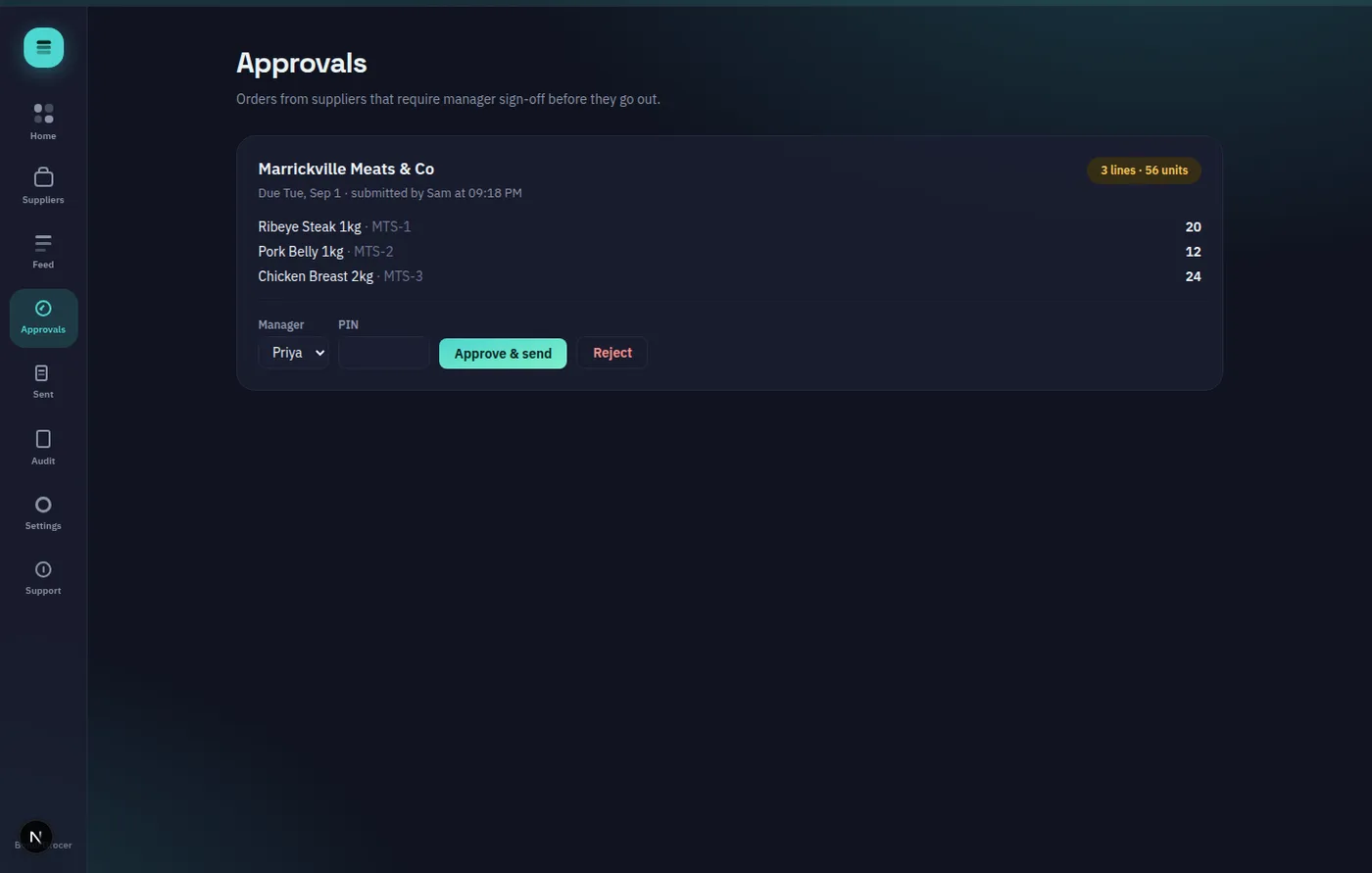 view and backed by a complete audit trail. The reasoning behind that design is covered in more depth on OnHand's homepage.
Trust, built into the system rather than assumed
Delegated inventory management isn't really a story about owners suddenly trusting their staff more. It's a story about systems finally making that trust something an owner doesn't have to extend blindly — because the guardrails, the visibility, and the accountability are built into the process itself. That's a much easier kind of delegation to say yes to, and it's a large part of why floor staff are being handed real inventory ownership more often than they used to be.