Margin pressure in independent retail and hospitality isn't new, but the scale of it right now is forcing operators to look in places they used to ignore. When wholesale prices were more stable and margins had a bit of slack, a clunky ordering process was just an annoyance. Now that every percentage point of margin is being fought for, that same friction is starting to look like a real, measurable cost — and increasingly, an avoidable one.
Where the squeeze is actually coming from
The pressure on independent grocers, cafes, restaurants and bars is coming from multiple directions at once: supplier costs that have risen faster than retail prices can comfortably follow, wage costs that continue to climb, and customers who are more price-sensitive than they've been in years. None of that is under a single operator's control. What is under their control is how efficiently the business runs around the edges of those fixed pressures — and ordering is one of the biggest edges.
It's a common pattern in the sector: an independent venue's ordering process is still built around habit rather than data. A manager orders roughly what was ordered last week, adjusted by gut feeling, because building an accurate picture of actual consumption by hand is tedious enough that nobody has time to do it properly on top of everything else running a small operation demands.
The two failure modes that eat margin quietly
Ordering friction shows up as margin loss in two opposite ways, and most operators are absorbing both without fully realizing it.
The first is over-ordering — buying more than needed "to be safe," which ties up cash in stock sitting on a shelf or in a cool room, and for anything perishable, turns directly into wastage. The second is under-ordering, or simply missing an order cycle entirely, which shows up as empty shelves, a menu item that can't be served, and customers who quietly go elsewhere. Both problems stem from the same root cause: nobody has a reliable, low-effort way to know exactly how fast a given product is actually moving, so orders get placed on instinct instead of information.
Layered on top of that is the time cost. A stock count done by memory and paper, a phone call to a supplier to place an order verbally, a follow-up call because the order wasn't confirmed — all of that is staff time that isn't spent on customers, and staff time is one of the most expensive line items an independent venue has right now. When margins were fatter, that time cost was easy to absorb. It no longer is.
Why this is now treated as a margin problem, not an ops problem
The shift happening across the sector is one of framing. Ordering friction used to be filed under "the way things are done" — an operational quirk, not a financial lever. As margins compress, operators are increasingly recognizing it as one of the few remaining levers they actually control. Supplier pricing is largely fixed by the market. Labor costs are largely fixed by legislation and competition for staff. But the accuracy and efficiency of the ordering process itself is entirely within the operator's own hands, which makes it one of the more attractive places to look for margin recovery precisely because it doesn't require raising prices or cutting staff.
This is where a purpose-built ordering tool earns its place, not as a nice-to-have but as a direct response to margin pressure. A system that tracks actual average daily sales per product and suggests an order quantity from that — cover period times sales rate, plus a small safety buffer, rounded to a supplier's real pack size — replaces guesswork with a number grounded in what the store has actually been selling. Crucially, the suggestion is exactly that: a suggestion. A person still reviews and can override every number before anything is sent, which matters because no algorithm has full visibility into a promotion starting next week or a supplier substitution. The point isn't to remove judgment from ordering, it's to remove the guesswork underneath it.
Seeing the actual mechanics of how a suggested order quantity gets built — and overridden — is easier than describing it; OnHand's product overview walks through the 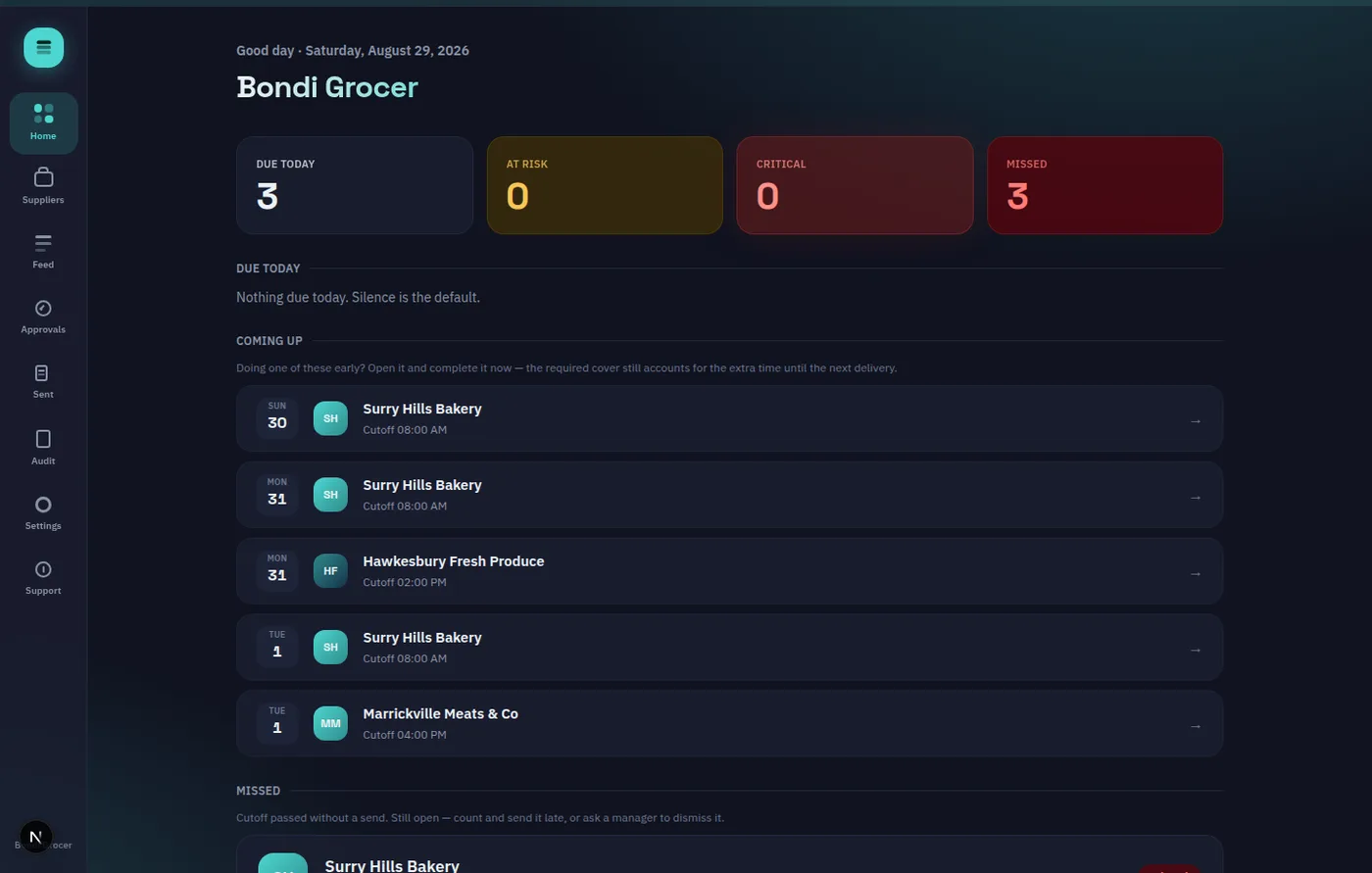 view that ties this together for a whole supplier schedule at a glance.
The bigger picture
Margin squeezes tend to force businesses to get honest about where their real costs sit, and for a lot of independent retail and hospitality operators, ordering friction has turned out to be a bigger one than expected — not dramatic, not a single bad decision, just a slow accumulation of small inefficiencies that thinner margins can no longer quietly absorb. Fixing it isn't glamorous work, but in a margin environment this tight, it's some of the highest-leverage work available.