The core claim, and why it's true
Paper doesn't calculate, doesn't remember, and doesn't warn you. Every one of those three gaps has a real dollar cost attached — they're just spread thin across dozens of small decisions a week, which is exactly why nobody notices the total until they actually add it up.
Ask any store manager running paper clipboards whether they're wasting money, and most will say no — nothing feels broken. That's precisely the problem. Paper-based waste doesn't show up as one alarming number on a P&L line. It shows up as a slightly-too-generous order here, a slightly-too-late order there, a repeated mistake nobody connected to the last time it happened. None of it looks like a crisis. All of it adds up.
Where the money actually leaks
1. Over-ordering that nobody's tracking against
A clipboard tells you what's on the shelf right now. It doesn't tell you, at a glance, how that compares to what you actually sold since the last count, or what a mathematically sound order quantity should be based on that real rate. Without that comparison sitting in front of them, most people round up — see our piece on why junior staff over-order perishables for the psychology behind this. A consistent 10-15% over-order on fast-moving perishables, week after week, is real money going straight in the bin, and it never shows up as a single number because it's spread across dozens of lines.
2. Missed cutoffs with no warning system
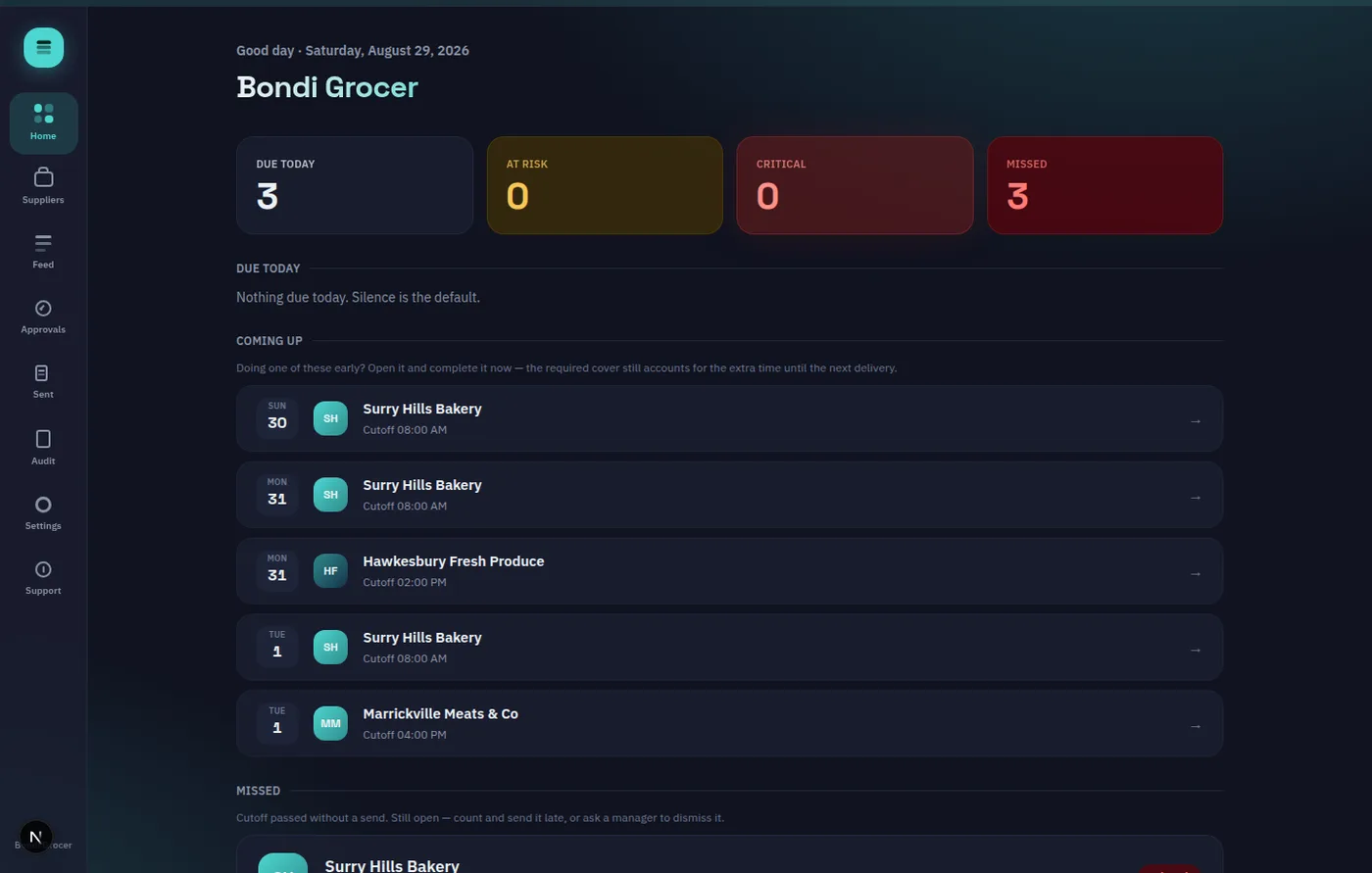
Paper doesn't escalate. A written cutoff time sits quietly on a clipboard whether it's two hours away or already passed — nothing about the format itself draws attention as the deadline approaches. A missed cutoff on a high-margin line (a butcher's fortnightly order, a Friday produce order ahead of the weekend rush) can mean an empty shelf during your best trading period. That's not a small loss.
3. No memory of what happened last time
A clipboard's count from three weeks ago is either filed away somewhere nobody checks, or it's already been thrown out. That means every ordering decision is made fresh, with no reference to how that line actually performed recently — no way to spot a genuine trend (a product picking up in popularity, or quietly declining) versus a one-off blip. Decisions made without history repeat the same mistakes, because there's no record to learn from.
4. Errors that compound silently across handoffs
Paper gets handed from the counter to whoever builds the actual order, sometimes to a third person who sends it. Every handoff is a place a number can get misread, a line can get skipped, or a note ("check the use-by on this one") can get lost entirely. None of these individual slips look serious. Across a year of daily counts, they add up to a meaningful amount of both wasted stock and wasted staff time re-checking and correcting.
5. Notification noise that trains people to stop looking
Some stores react to clipboard chaos by over-correcting into constant check-ins — a manager texting the group chat about every order, every day, "just to be safe." That has its own cost: after a few weeks, people stop reading the group chat closely because most of it doesn't need action. The genuinely urgent message — a cutoff about to be missed — gets the same level of attention as the routine "order sent" update, which is to say, not much. A system that only speaks up when something's actually at-risk avoids training people to tune it out.
6. No visibility for anyone who isn't standing at the clipboard
If the manager isn't physically in the stockroom, they have no idea whether today's counts have even happened, whether an order's on track, or whether something's about to be missed. That blindness means problems only get caught after the fact — after a shelf's already empty, after a cutoff's already passed — rather than while there's still time to act.
What actually fixes this — and what doesn't quite
A spreadsheet is a half-step up: it can do the arithmetic paper can't, but it still doesn't proactively warn anyone, still doesn't update live as someone's counting, and still depends entirely on someone remembering to open it and keep it current across every supplier's own schedule.
The bigger shift is having the count, the calculation, and the warning system all live in one connected place — where a number typed in during a count immediately feeds a suggested order, and a deadline that's getting close actually surfaces itself instead of waiting to be noticed. That's the actual gap between paper (or a spreadsheet standing in for paper) and a system built for this specific job.
Crucially, none of this means giving up control of the numbers. The suggested quantity should still be reviewed and can still be overridden every single time before anything's sent — the point isn't to remove the human judgment, it's to give that judgment a real, calculated starting point instead of a blank field.
If you want to see what this looks like without committing to anything, OnHand's live demo is open with no signup required — walk through a real count and watch the suggested order calculate itself. And the free tier (one supplier, no card needed) is a genuinely low-risk way to trial this on your single busiest supplier before deciding whether it's worth rolling out further, covered on the OnHand homepage.
The clipboard isn't costing you one big number. It's costing you a hundred small ones, every single week — and that's exactly why it's worth actually adding up.