Standardizing ordering across multiple independent locations works best when it separates two things that get conflated too often: the process (how ordering happens, what tooling everyone uses, what data everyone can see) and the specific local decisions (cutoff times, order days, which suppliers to use). The first is worth centralizing. The second usually isn't, because it genuinely differs store to store — and over-centralizing it tends to create more problems than it solves.
This distinction matters because "standardize ordering" can mean two very different projects. One makes every location run on the same reliable, auditable process. The other tries to make every location behave identically, which usually fights against real local differences that exist for good reasons.
What's actually worth standardizing
1. The tool everyone uses. If site A orders through a spreadsheet, site B through a POS module, and site C by phoning suppliers directly, there's no consistent record, no comparable data across locations, and no way for a network-level admin to see the full picture. A single shared ordering system — even if each location configures it differently — solves this.
2. Product codes and descriptions. If the same supplier sells the same product to three of your locations, it's worth those three sites working from the same SKU, name, and pack size, rather than each site inventing its own naming convention. This is a real, common pain point for small multi-site groups, and a shared master product list (maintained centrally, pulled into each location) solves it cleanly.
3. The math behind suggested order quantities. The formula — average daily sales against days until next delivery, rounded to pack size — should be the same everywhere. What that formula outputs will naturally differ by location, because each site's actual sales differ. Standardizing the method, not the number, is the right target.
4. Visibility for oversight. A network-level manager should be able to see order status across every location — what's due, what's at risk, what's been missed — without having to log into each site separately.
What's usually NOT worth standardizing
1. Cutoff times and order/delivery days. Two locations of the same small chain can genuinely have different delivery logistics — different supplier relationships, different truck routes, different local circumstances. Forcing identical schedules onto sites with different real-world constraints creates friction without benefit. This is a deliberate scope decision worth respecting rather than "fixing" toward uniformity.
2. Which suppliers each site uses. A shared network-level supplier list is useful as a menu each location can draw from — but the actual choice of which suppliers to use, and the specific relationship terms (order email, sales rep contact) with each, reasonably stays local. A head-office-mandated supplier list, without local flexibility, tends to ignore real differences in what's actually available or reliable region to region.
3. Approval thresholds. One location's "expensive order worth a manager's second look" may be a different dollar amount or product category than another's, depending on that site's own margins and volume. Forcing an identical approval threshold across sites can either annoy a high-volume location with unnecessary friction or under-protect a lower-margin one.
A working model: shared list, local control
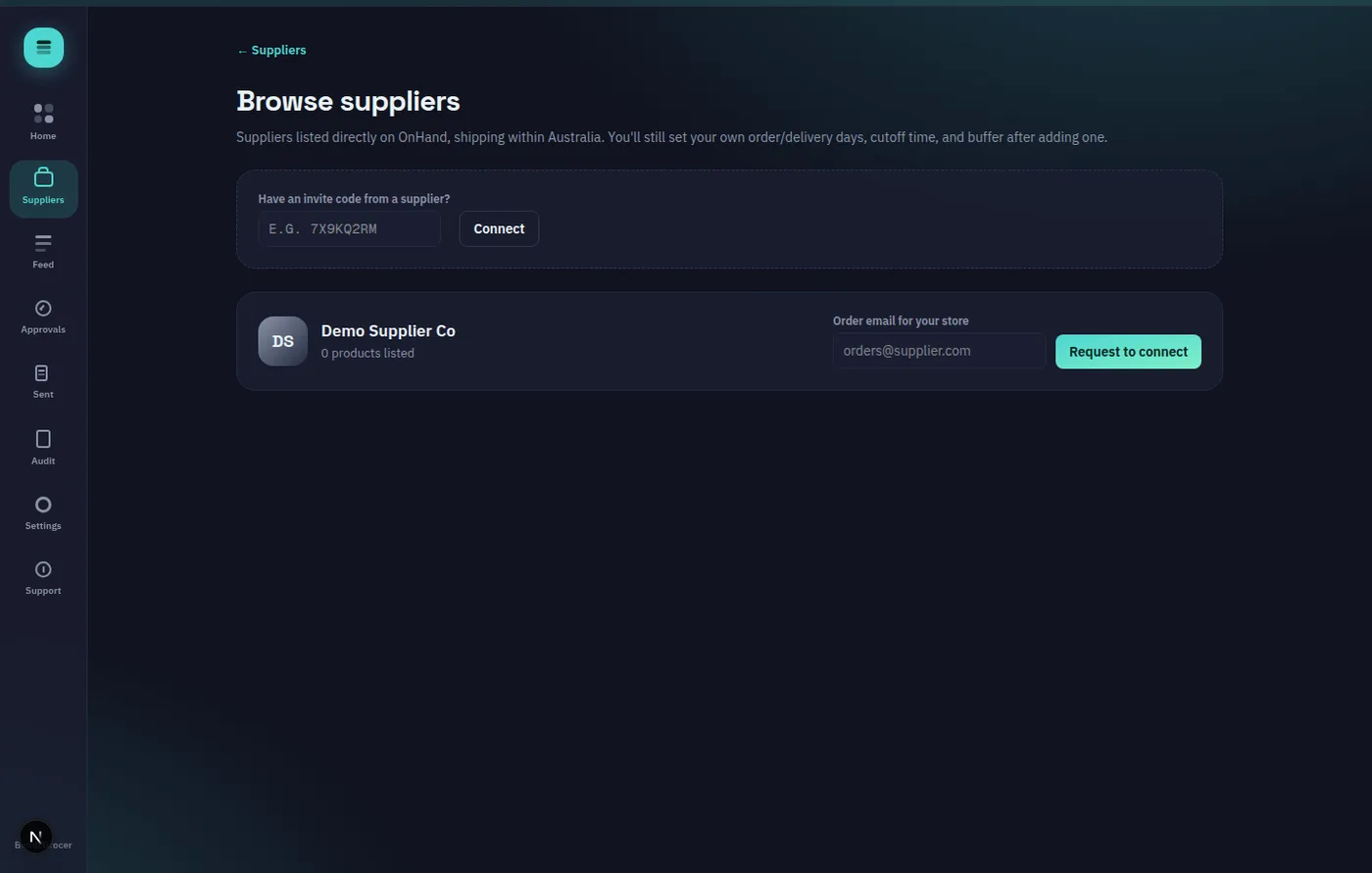
A practical pattern for small multi-site independent groups is a master supplier/product list maintained once, at the network level, with each individual location retaining full control over its own cutoff times, order days, and supplier email contacts. New products added to the master list flow down to every linked location automatically; each site still configures its own schedule and still reviews and can override every suggested order quantity before it sends. This gets the consistency benefit (same product data, same tooling, same process) without the over-centralization cost (identical schedules that don't fit every site's reality).
OnHand's network-licensing model for multi-site operators works on exactly this split — a shared master supplier/product list maintained by a network admin, while cutoff times and delivery days stay entirely store-configured, because, as the reasoning behind that design put it plainly: each site's ordering logistics genuinely differ, and no head office should override that.
The honest limits of standardization
If your locations are different enough in format (a full supermarket and a small express store under the same banner, say) that even the product mix barely overlaps, a shared master list buys less than it would for genuinely similar-format sites. Standardization pays off in proportion to how similar the underlying operations actually are — it's not free consistency for its own sake.
Getting a sense of this in practice
If you're managing more than a couple of independent locations and want to see how a shared-list, local-control model actually works, a single-location demo walkthrough shows that version of the workflow end to end — a useful starting point before evaluating the multi-site setup, and the full pricing and plan breakdown covers what's available at each scale.