The reframe that makes shrinkage solvable
"Shrinkage" sounds like one problem. In fresh produce, it's almost always three separate problems wearing the same trench coat: over-ordering relative to real demand, poor rotation letting older stock hide behind newer stock, and loss that never gets recorded so nobody can see the pattern. Treat them as three separate fixes and shrinkage stops being a vague, discouraging number and starts being a short list of specific actions.
Produce is the department every manager worries about most, and for good reason — it's perishable, it's margin-sensitive, and it's the department where a bad week is visible fast: bins of wilted greens, discounted trays of berries nobody wanted at full price. But "shrinkage is high" is rarely one cause. It's worth pulling apart.
Cause one: ordering more than you're actually selling
This is the biggest lever, and the most fixable. Produce demand shifts constantly — weather, day of week, local events, seasonality — and if your ordering is based on habit ("we always order 40kg of this") rather than actual recent sales, you're baking in over-ordering as a permanent fixture rather than an occasional mistake.
The fix is a suggested order quantity calculated from real, recent average daily sales for that specific line, not a round number carried over from last month out of habit. When that suggestion also accounts for how many days until your next delivery — not a fixed "we always order a week's worth" assumption — it stops padding every order with unnecessary safety margin.
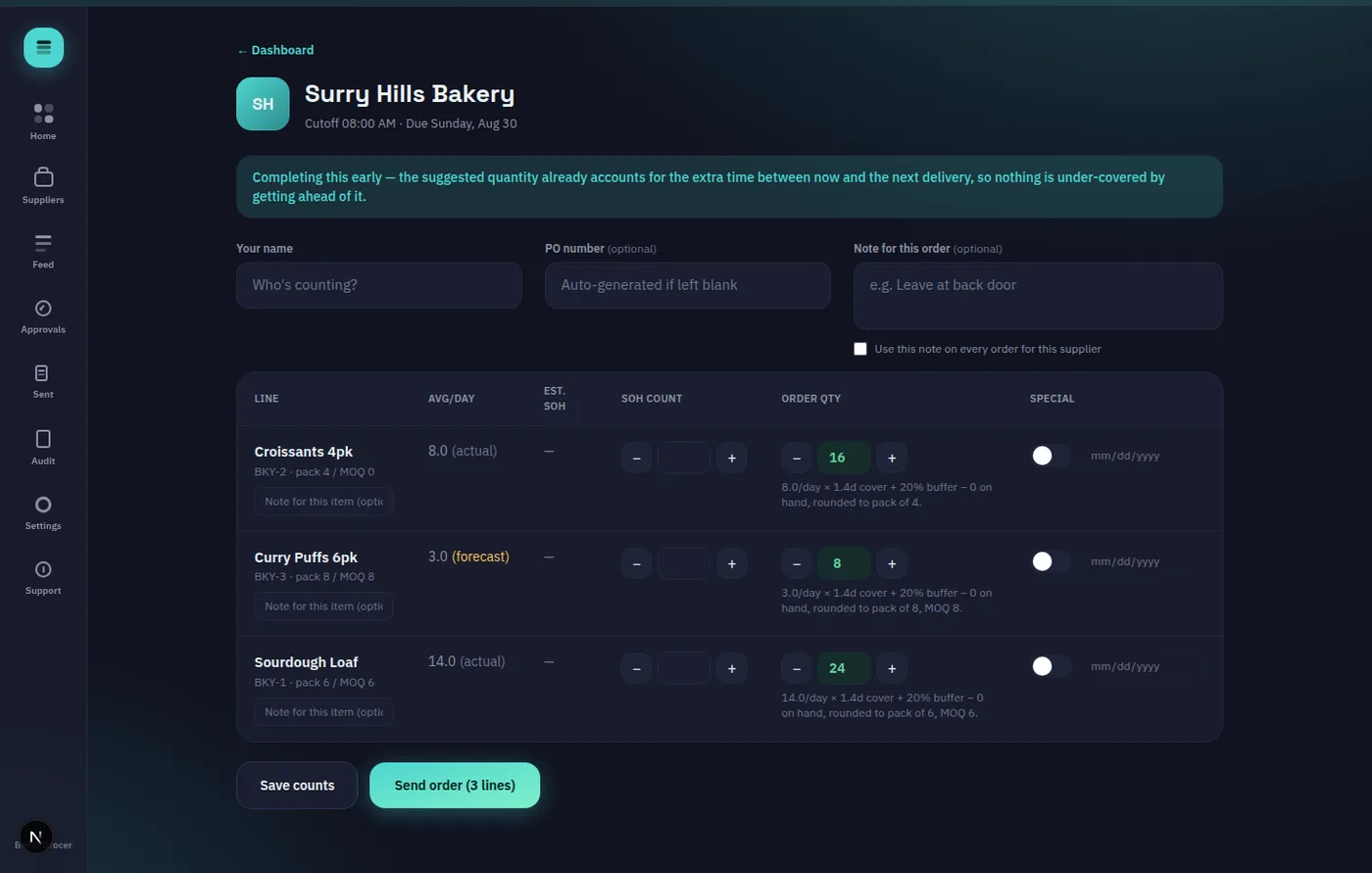
This matters even more for anything you sell by weight — a tray reading 2.3kg of a slow-moving berry variety is a genuinely different order decision than one rounded up to "3," and produce is exactly where decimal accuracy in counting and ordering earns its keep.
Cause two: rotation that lets stock hide until it's too late
Even a perfectly-sized order goes to waste if older stock isn't being sold or used before newer stock. This is a physical layout and habit problem more than an ordering one — see our companion piece on stockroom layout for the specifics — but for produce specifically, a few things matter more than elsewhere:
- Front-facing date visibility. If checking freshness means moving trays around, it gets skipped during a busy shift.
- A genuinely enforced first-in-first-out habit, not just a sign that says to do it.
- A daily glance at what's closest to turning, not a weekly one — produce moves fast enough that a week between checks is often too long.
Cause three: loss that never gets recorded, so nobody can see the pattern
This is the quiet one. A tray gets binned, someone notes it mentally (or doesn't note it at all), and by the time stocktake rolls around, all you know is "the number's off" with no idea why. Without a record of what was lost and when, you can't tell whether this week's shrinkage is a one-off (a delivery that arrived already past its best) or a genuine, recurring pattern on a specific line.
Attaching a note to a line the moment something's noticed — "half this tray had to be binned, check delivery condition next time" — turns a vague feeling of "produce shrinkage feels high lately" into a specific, dated record you can actually act on. Over a month, that record tells you exactly which lines are the real problem, rather than leaving you to guess.
A note on seasonal swings
Produce shrinkage tends to spike at seasonal transitions — the week a summer stone-fruit line starts winding down, or the first cold snap when leafy greens turn faster than usual. This is exactly when a habit-based order ("we always get 30kg on a Tuesday") does the most damage, because the actual sales rate has already shifted but the order hasn't caught up yet. If your ordering is based on a recent, rolling average rather than a fixed weekly habit, it naturally adjusts down as a line's season winds out — one less thing to remember to manually correct for every single transition.
Putting the three fixes together
A produce department that's tackling all three at once looks like this: counts happen daily on the fast-moving lines, the suggested order for each is based on real recent sales rather than habit, rotation is physically easy to maintain because the layout supports it, and anything unusual gets noted at the moment it's spotted rather than lost to memory. None of these individually is a big lift — together, they're what actually moves the shrinkage number, because they address all three real causes instead of just one.
Where to start this week
Pick your three worst-performing produce lines by however you currently measure waste — bins, markdowns, whatever record you've got — and check each against the three causes above. Is it consistently over-ordered relative to what actually sells? Is it sitting somewhere that makes rotation hard? Is loss on this line even being recorded, or just absorbed silently into a stocktake variance nobody's traced back?
If you want to see what a live, decimal-accurate count and suggested order looks like for weight-sold produce specifically, OnHand's live demo is open with no signup needed. And our piece on the five-minute daily stocktake system covers the counting habit that underpins all three fixes above — it's the same daily walk, just applied with produce's particular risks in mind.
Shrinkage isn't one number to chase down — it's three separate habits to build, and each one is genuinely manageable on its own.