Four bottlenecks account for most of the recurring inventory pain independent retailers report: missed or late supplier orders, guesswork-based order quantities, notification overload that trains staff to ignore alerts, and no lightweight way for a manager to review the orders that actually warrant it. Each has a distinct root cause, and each has a distinct — sometimes only partial — technology fix worth understanding honestly rather than assuming software solves all four equally well.
Bottleneck 1: Missed or late supplier orders
The pattern: an order doesn't go out on time, not because nobody could have caught it, but because tracking supplier cutoff times lived in one person's memory or a sticky note, and that person was busy, sick, or simply didn't check the calendar that day.
Why it happens: most stores manage multiple suppliers with different order days, different cutoff times, and sometimes non-weekly schedules (fortnightly, monthly). Holding all of that correctly in someone's head, every week, without a system, is genuinely hard — this isn't a competence problem, it's an information-management problem.
What actually fixes it: a system that tracks each supplier's schedule explicitly and surfaces a due-today/at-risk/missed state automatically, computed against the store's own timezone rather than a generic clock. This removes the dependency on any one person remembering — the system remembers instead.
What it doesn't fix: a supplier relationship where the supplier themselves is unreliable about lead times. Tooling can only track the schedule you give it; it can't fix a supplier who doesn't honor their own stated lead time.
Bottleneck 2: Guesswork order quantities
The pattern: orders are placed on gut feel or a rough habit ("we always order two cases"), leading to a steady mix of over-ordering (waste, especially on perishables) and under-ordering (stockouts, lost sales).
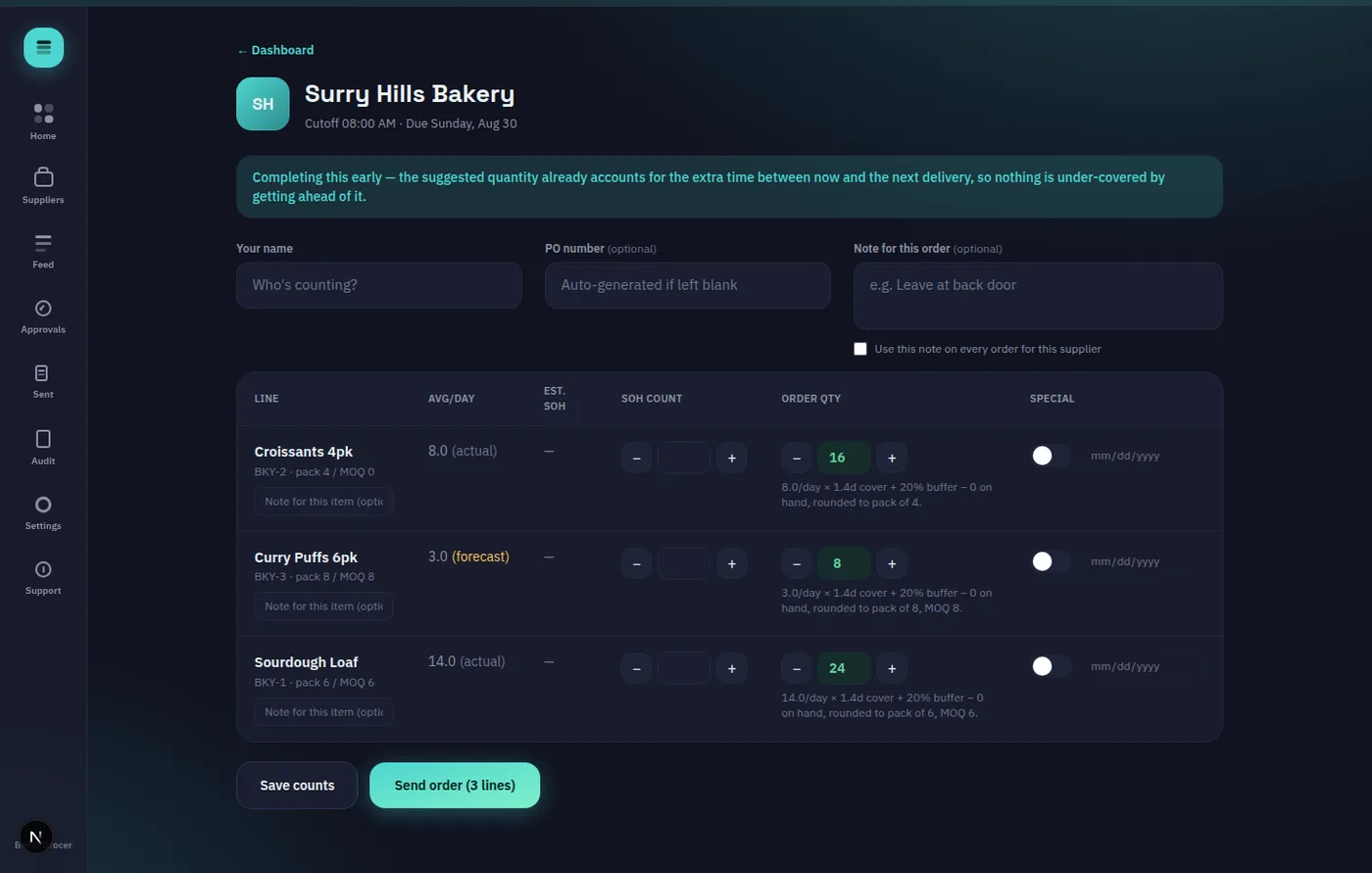
Why it happens: calculating a genuinely sales-aware order quantity by hand — average daily sales, days until next delivery, current stock on hand, safety buffer — is tedious enough that most people don't do it consistently, even if they know how in principle.
What actually fixes it: a deterministic calculation run automatically every time, using real average sales and the actual cover period until the next delivery, rounded to pack size and floored at minimum order quantity. Crucially, this should be a suggestion a person reviews and can override — not an auto-send — since local knowledge (a delivery already inbound, a promo starting tomorrow) still matters and a formula can't see everything.
What it doesn't fix: a genuinely new or highly seasonal product with no sales history yet — any calculation needs some real data to work from, and a brand-new line starts as an educated guess regardless of the tool.
Bottleneck 3: Notification overload
The pattern: a system (or a person) sends updates on every single stock or order event, and staff learn — reasonably — to ignore notifications entirely, including the ones that actually matter.
Why it happens: more notifications feels like more visibility, so tools and processes tend to default toward over-notifying rather than under-notifying, without considering the cost of alert fatigue.
What actually fixes it: silence as the deliberate default — nothing due today produces no alert at all, and notifications only fire for states that genuinely need a decision (at-risk, critical, missed). This is a design choice, not a technical limitation, and it's worth specifically asking any vendor whether their default behavior is "notify on everything" or "notify only when it matters."
What it doesn't fix: a team culture where alerts of any kind get ignored regardless of relevance. If the underlying discipline of checking the system daily isn't there, even a well-designed alert won't reach anyone.
Bottleneck 4: No lightweight manager oversight
The pattern: either every order requires manager sign-off (slow, resented, and eventually bypassed) or no order does (and an expensive mistake eventually slips through with nobody catching it).
Why it happens: most tools offer approval as an all-or-nothing store-wide setting, forcing a binary choice between speed and oversight rather than letting a store apply oversight only where it's worth the friction.
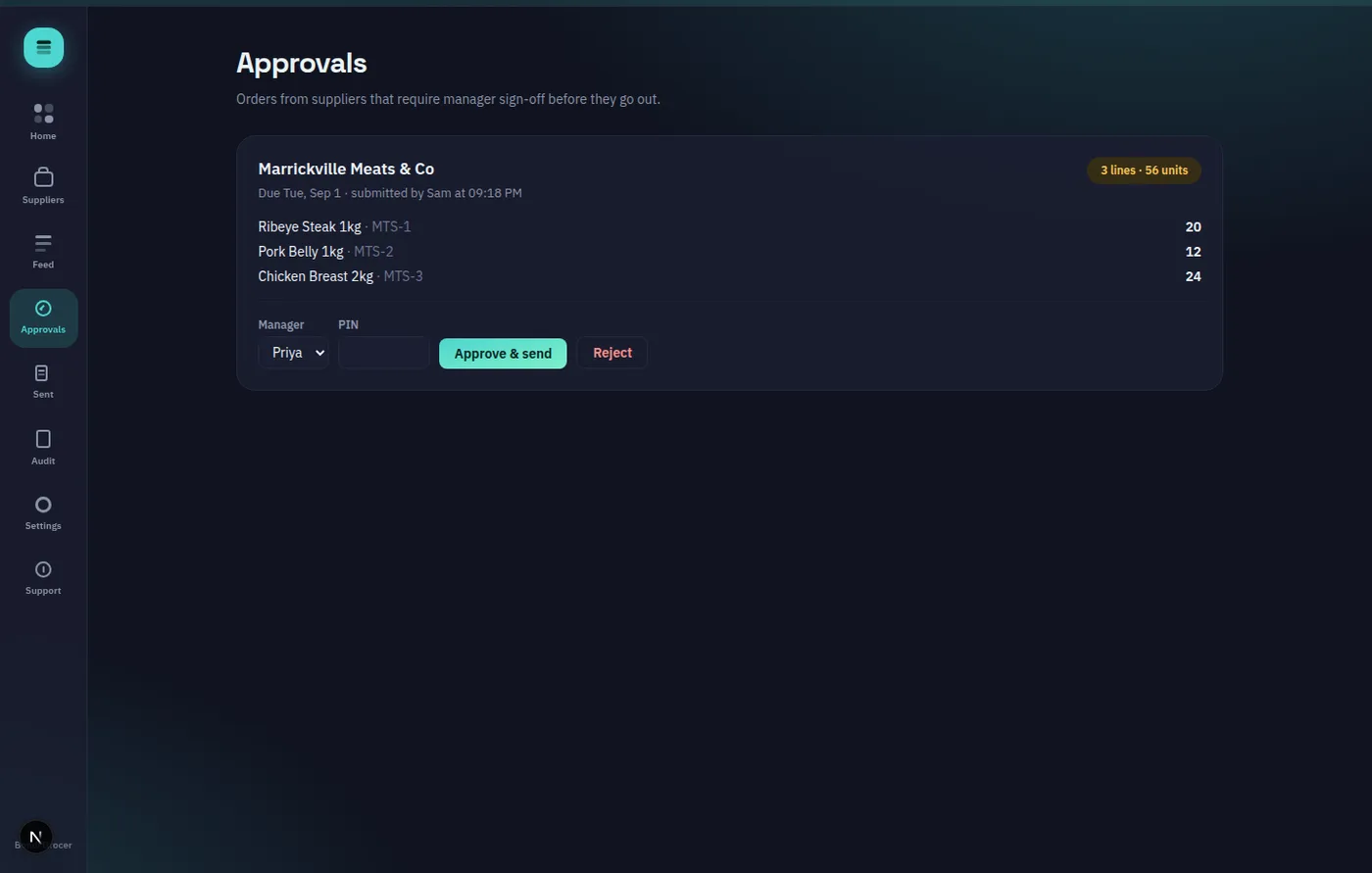
What actually fixes it: per-supplier approval control — a lightweight sign-off (a manager PIN, checked fresh each time, no full login required) switched on only for the suppliers where a mistake is genuinely costly, while routine orders keep flowing untouched.
What it doesn't fix: a store with no manager available at the moments approval is actually needed. The workflow only helps if someone's actually there to approve — this is a staffing question tooling can't answer.
Auditing your own operation
Not every bottleneck bites every store equally — a single-supplier operation may never feel notification overload, while a twelve-supplier operation feels all four at once. Before adopting any tool, it's worth honestly rating which of these four actually cost you time or money today, rather than solving for all of them uniformly.
Seeing the fixes in practice
OnHand was built around addressing these four specifically — cutoff tracking, deterministic order-quantity suggestions, silent-by-default alerting, and per-supplier approval — for independent stores rather than enterprise chains. The interactive demo walks through all four in a real, working flow with no signup required, so you can judge for yourself whether the fixes actually match the bottlenecks you're feeling.