Independent grocers can realistically match enterprise supermarket chains on operational precision — accurate stock counts, disciplined ordering, minimal waste — without matching their budgets, because that precision comes from process and tooling, not from scale. What independent stores genuinely can't match is bulk purchasing power and dedicated logistics infrastructure, and it's worth being clear-eyed about that distinction rather than pretending software closes every gap.
This matters because "compete with the big chains" gets thrown around vaguely in a lot of small-business advice, without separating what's actually achievable from what isn't. Below is a specific, honest breakdown.
Where the gap is real and software won't close it
Large chains have advantages independent grocers structurally cannot replicate at small scale:
- Bulk purchasing discounts tied directly to volume commitments
- Private-label manufacturing, which requires production-scale relationships
- Dedicated logistics and warehouse networks, amortized across hundreds of stores
- Enterprise data science teams building custom demand models across millions of transactions
No inventory app changes any of this. It's worth naming honestly rather than implying a $49/month subscription somehow neutralizes a chain's supply-chain scale — it doesn't.
Where the gap is closeable — and where the real opportunity is
The part of "enterprise precision" that's actually about process discipline, not scale, is much more within reach:
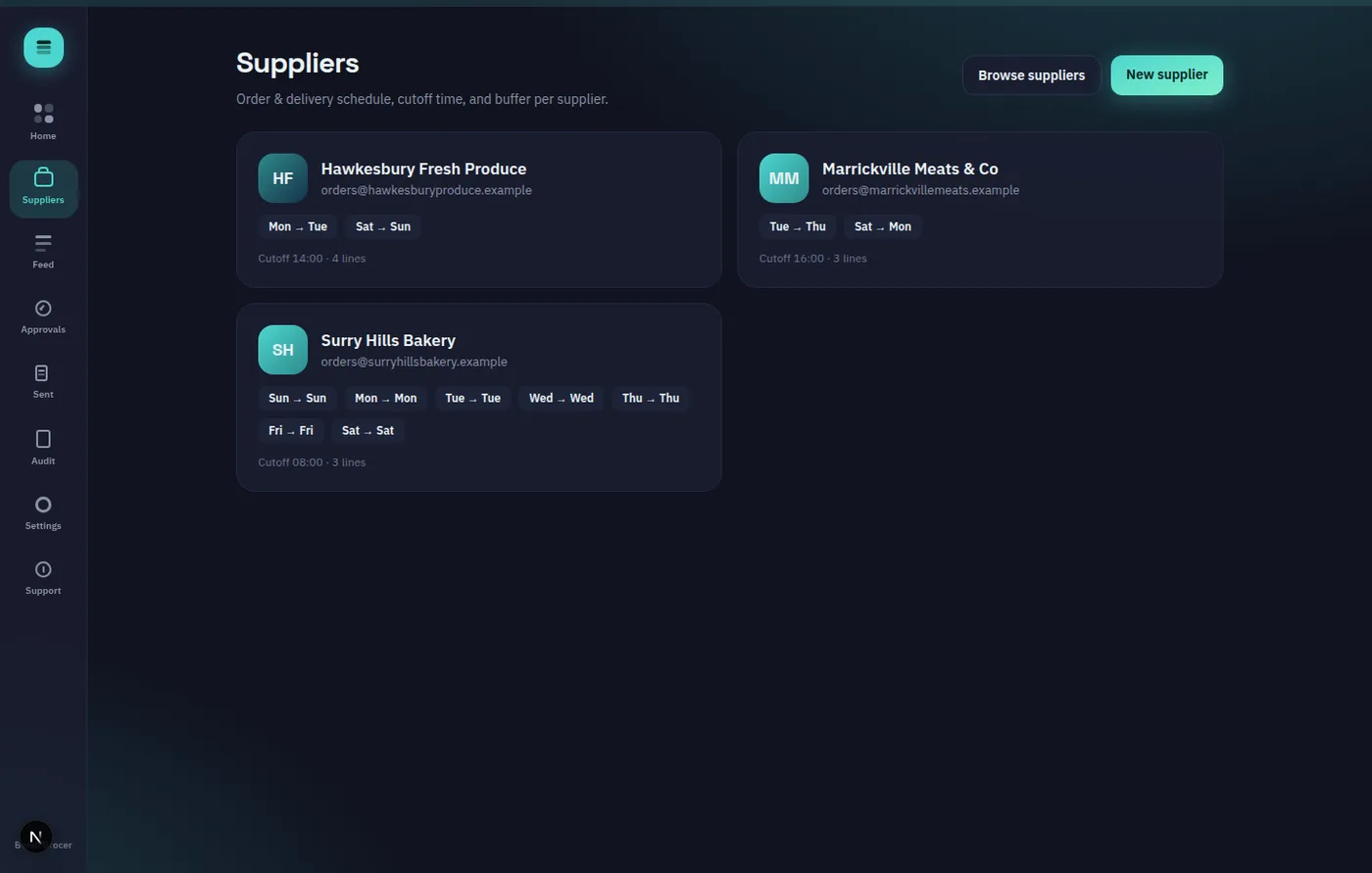
1. Consistent, disciplined ordering cadence. Chains don't miss supplier cutoffs because they have systems that track them automatically, not because they have more staff watching a calendar. A small store can get the identical discipline from a tool that tracks per-supplier cutoff times and flags at-risk orders — the underlying logic doesn't require enterprise scale to run correctly, just correct configuration.
2. Sales-aware order quantities. Big chains don't order by gut feel; they use real average-sales data against real cover periods. That same deterministic calculation — average daily sales × days until next delivery, plus a small safety margin — works exactly the same whether you're ordering for one store or five hundred. The formula doesn't get smarter with scale; it just gets applied more often.
3. Waste reduction through accurate counts. A meaningful chunk of independent-grocer margin loss is simple over-ordering on perishables, compounding quietly over months. Chains fight this with tight stock-count discipline. A small store can run the identical discipline with a proper stocktake workflow — it's a process advantage, not a budget one.
4. Manager oversight without slowing everything down. Enterprise procurement has layered approval processes. A small store doesn't need that much overhead, but can borrow the underlying idea at a fraction of the weight — an optional approval step on the specific supplier orders worth a second look, rather than every order.
An underrated advantage independent grocers actually have
Chains optimize for consistency across hundreds of locations, which means individual store managers often have limited authority to adjust for local conditions. An independent grocer can react to a local supplier relationship, a community preference, or a one-off event far faster than a corporate approval chain allows — that's a genuine structural advantage worth leaning into rather than only trying to close gaps in the other direction.
What this actually costs
The tooling layer of this — cutoff tracking, sales-aware order math, silent-by-default alerting, optional approvals — doesn't require enterprise budget to access. Some tools in this space, including OnHand, offer a genuinely free tier for a single supplier with no card required, scaling up modestly from there (a paid tier for a handful of suppliers currently runs around $49/month). That's a small fraction of what a single over-large perishable order or a missed weekly delivery typically costs in wasted stock or lost sales.
The honest summary
Independent grocers can match enterprise-level ordering discipline on a modest budget. They cannot match enterprise-level purchasing power or logistics scale, and shouldn't pretend otherwise when making the case to themselves or their team. The realistic strategy is to close the precision gap where it's actually closeable, and compete on the things scale can't buy — local relationships, faster decisions, and a store that feels like it's run by a person rather than a system.
Getting a sense of the tooling side
If the ordering-discipline piece is the part you want to shore up first, it's worth ten minutes in a free, no-signup demo to see the actual mechanics — the stock count, the suggested quantity, the review step — before deciding whether it's worth adopting for your store.