The fix in one sentence
Missed cutoffs happen because the deadline lives in someone's memory instead of on a clock that fires a warning before it's too late — fix the second part and the first part stops mattering.
Every store manager has lived this exact afternoon: it's 1:40pm on a Thursday, the butcher's order is due by 2pm, and you're three deep in a delivery dispute at the front counter. By the time you look up, it's 2:15pm and the cutoff's gone. Now Saturday's cabinet is short on lamb racks during your best trading day of the week.
This isn't a discipline problem. It's a visibility problem. The fix isn't "try harder to remember" — it's building a system where the deadline announces itself before it's urgent, not after.
Why "just remember" doesn't survive a busy shift
On a quiet Tuesday, a mental note works fine. On a Friday with three deliveries arriving, a broken freezer, and a casual calling in sick, mental notes are the first thing that gets dropped. The busier the shop floor, the more likely the order gets pushed to "after this next thing" — and "after this next thing" is exactly how a 2pm cutoff becomes a 2:15pm miss.
The stores that never miss cutoffs share one trait: the deadline is externalized. It's not in anyone's head. It's on a wall, a phone, or a dashboard, and it escalates on its own as the deadline approaches.
Build a cutoff system that survives chaos, not just quiet days
1. Write down every supplier's actual cutoff — not the "usual" one
Suppliers don't all cut off at the same time, and they don't all deliver on the same cadence. Your bread supplier might be a same-day 6am order for next-day delivery. Your butcher might run fortnightly on a Tuesday-for-Thursday schedule. Your dry goods wholesaler might be Monday/Wednesday/Friday. If this list only exists as tribal knowledge, you're one staff turnover away from losing it entirely.
Get it in writing, per supplier: cutoff time, order day(s), delivery day(s), and how often the cycle repeats. Some of this is genuinely fortnightly or monthly — treating it as "just weekly, roughly" is how a store ends up ordering a week early or a week late without noticing.
2. Separate "due today" from "just started counting down"
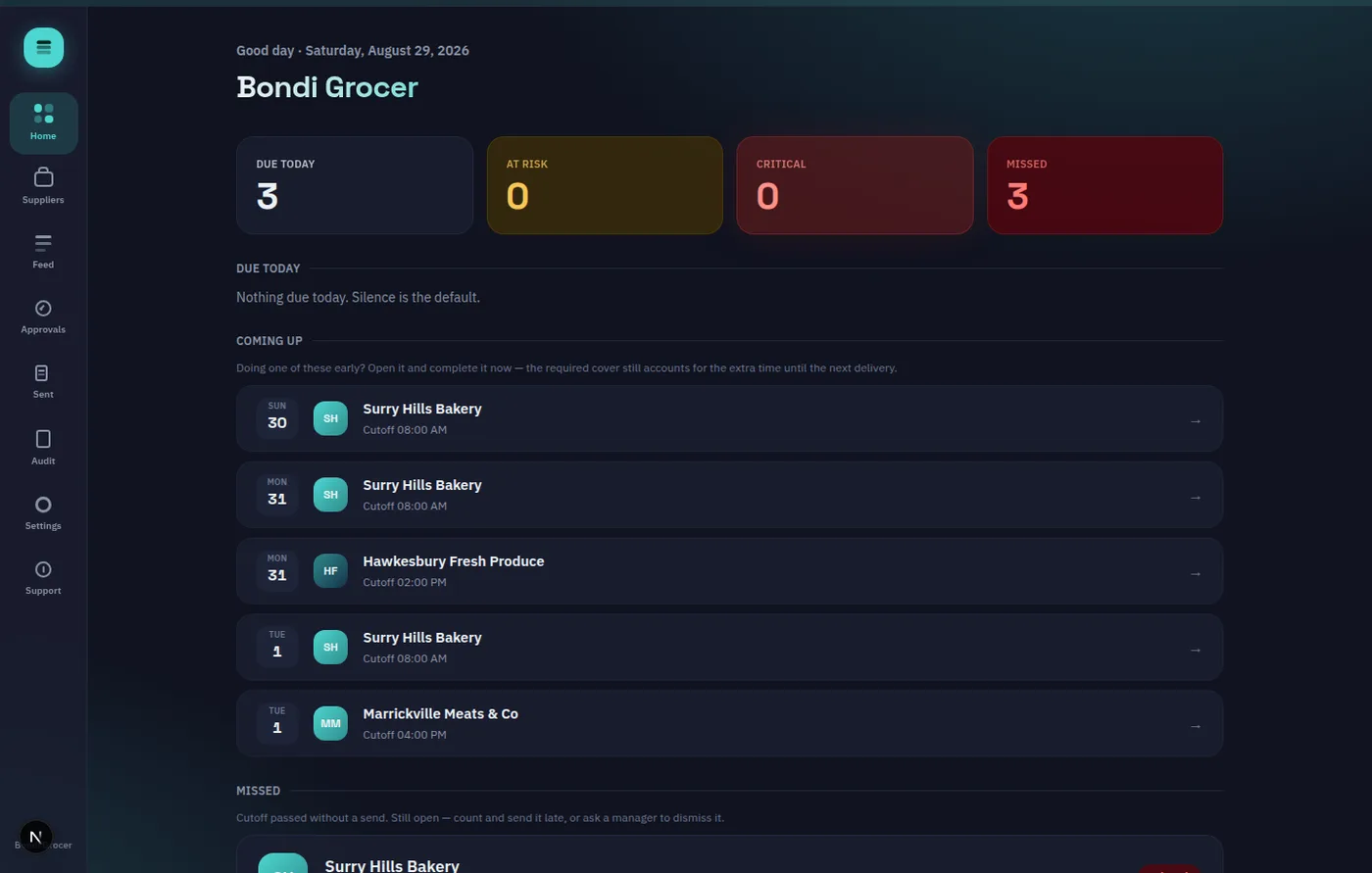
The single biggest improvement most stores can make is distinguishing between an order that's due today and one that's merely on the horizon. A dashboard-style view — due today, coming up, at risk, missed — does this automatically instead of making a person mentally triage a flat list every morning. OnHand's own dashboard computes exactly these four states from each supplier's own cutoff, in your store's actual timezone, so nobody has to do the mental math of "is 2pm close enough to worry about yet."
3. Make the warning fire before the deadline, not at it
An alert that fires exactly at cutoff time is useless — by then it's already too late to act. What actually helps is a warning that fires while there's still time to do something: count the stock, place the order, hit send. This is the difference between "at-risk" and "missed" as two separate states, rather than one binary "did we order or not."
Some version of this can be a physical whiteboard with a red line drawn an hour before each cutoff. It can also be automatic — OnHand can text or email a manager the moment an order crosses into at-risk territory, and stays silent otherwise. No noise on the routine orders, a real nudge on the ones actually heading for trouble.
4. Decide in advance who acts on the warning
A warning that nobody's assigned to act on is just background noise. Name a person (or a rotating role, like "whoever's on close") who owns cutoff monitoring for the afternoon shift specifically, since that's when most misses happen — mornings are typically calmer, afternoons are when deliveries, customers, and phone calls collide.
5. Review what actually got missed, weekly
Don't just move on after a miss. A five-minute Friday review — which cutoffs got close this week, which one actually got missed, why — turns a recurring problem into a one-time lesson. Patterns show up fast: it's almost always the same supplier, the same day, the same busy window.
What this looks like in practice
A produce order due at 10am on a Tuesday should show as "due today" from the moment the store opens, escalate to "at-risk" if nobody's touched it by, say, 9am, and only alert a manager directly if it's genuinely about to be missed. Nobody gets pinged about the Wednesday bread order that's not due for two more days — that's the "silent by default" principle worth building into whatever system you use, whether it's a whiteboard or software: alert on the exceptions, not on everything.
If you want to see what an automated version of this actually looks like day to day, the live demo walks you through a due-today dashboard with zero signup required — worth ten minutes if cutoffs are a recurring headache for your team. And if you're weighing whether to build this by hand or lean on something purpose-built, the OnHand homepage lays out how per-supplier cutoffs and alerts work end to end.
Missing a cutoff once is a bad afternoon. Missing the same one three months running is a system problem — and it's a fixable one.