For most of the history of independent retail, placing a wholesale order meant picking up the phone. A manager would call a sales rep, read off a list, and trust that what was heard on the other end matched what was actually needed. That process has been slowly replaced over the past two decades — first by fax and email, then by supplier ordering portals, and now by a newer model that treats an order less like a conversation and more like a structured, reviewable transaction.
The phone-call era, and its quiet cost
Voice-based ordering was never actually bad at its core job — a competent manager and a competent rep could place an accurate order over the phone for years without major incident. The real weakness was everything around the transaction. There was no record beyond whatever notes either party happened to jot down. Disputes about quantities or missed items came down to memory against memory. And the entire process depended on someone being available, at the right time, to make the call before a cutoff passed.
Fax and email order sheets improved the record-keeping slightly — at least there was a document — but didn't fundamentally change the shape of the process. An order was still a piece of unstructured content, a list typed or written out by a person, sent to another person, with no system on either end actually understanding what was in it as data rather than text.
What structured digital ordering actually changes
The real shift in wholesale ordering isn't that it moved onto a screen — it's that an order stopped being a message and started being a data structure. A modern ordering system understands, for each line, the exact product, the pack size, the quantity, and which supplier and delivery day it belongs to. That distinction matters more than it sounds: once an order exists as structured data rather than free text, a whole set of things become possible that were previously impractical, from automatically checking a quantity against a supplier's minimum order size, to keeping a permanent, searchable record of every order ever sent without anyone having to file anything by hand.
The most significant addition on top of that structure has been approval workflows — the ability to route a specific order through a manager's sign-off before it actually goes out, without requiring that manager to personally place every single order themselves. This is a meaningfully different model from either extreme: a manager placing every order personally (accurate, but a bottleneck) or a junior staff member placing every order unsupervised (fast, but risky for anything expensive or high-stakes). A narrow, per-supplier approval step — used only for the orders worth a second set of eyes, like an expensive meat order, while routine orders like bread go straight out — gets the benefit of oversight without reintroducing the bottleneck digital ordering was supposed to remove.
Why accountability, not speed, is the real story
It's tempting to frame this evolution purely as a story about speed — orders that used to take a phone call now take a few taps. That's true, but it undersells what actually changed. The bigger shift is accountability: a structured order carries a complete, timestamped record of who counted the stock, who approved the order, who sent it, and exactly what quantities were included — all captured automatically, as a byproduct of the process itself, rather than something anyone has to remember to document separately.
That record turns out to matter for reasons that have nothing to do with placing the order in the first place. It's the thing that resolves a dispute with a supplier about what was actually ordered. It's the thing that lets a new manager understand how a store has historically ordered from a given supplier without asking around. And it's the thing that makes delegating ordering to junior staff feel safe, because every action is genuinely traceable rather than trusted on faith.
OnHand's approach to this reflects that accountability-first framing directly — a lightweight, per-supplier manager-PIN approval step sits between "counted" and "sent," visible in the 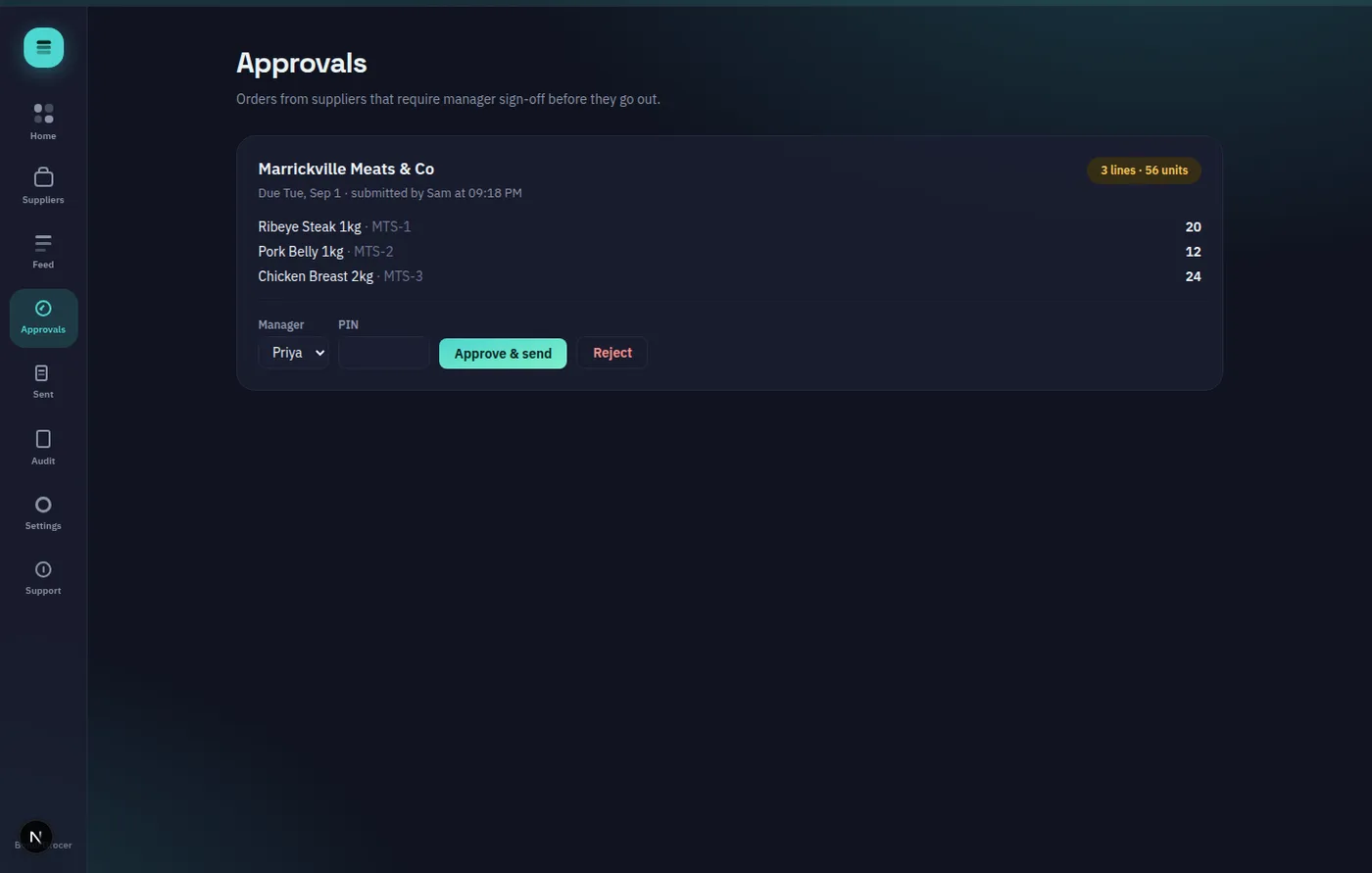 view, alongside a complete audit trail of every count, send, approval and rejection. Suppliers on the other side of these orders can see how the receiving experience fits together on OnHand's page for suppliers.
An order as a record, not just a request
The evolution from voicemail to instant, structured approval isn't really about getting orders out faster, even though that's a real side benefit. It's about an order finally becoming something a business can actually rely on afterward — searchable, attributable, and auditable — instead of a transaction that existed only for the moment it was made and then disappeared the way a phone call always did.