For most of the last fifty years, the defining tool of independent grocery inventory hasn't been a barcode scanner or a database — it's been a clipboard. A folded sheet, a pen on a string, a walk down each aisle counting cans and cartons by eye. That artifact is disappearing, not because paper stopped working, but because the rest of the business finally caught up to how much it was quietly costing.
Why the clipboard lasted this long
The paper stock count survived so long because it's genuinely hard to beat on simplicity. There's no login, no app to open, no training required — anyone who can write can do it. For a two-person cafe or a family-run corner grocer, that low barrier to entry mattered more than any efficiency gain a computer might offer, especially in an era when "inventory software" meant a five-figure enterprise system built for a chain with a warehouse and a logistics team.
But the clipboard has always had a structural weakness: it's a snapshot, not a record. The moment that sheet gets filled in, faxed or read aloud over the phone to a supplier, the information on it effectively evaporates. Nobody can easily ask "what did we count last Tuesday" or "how has this line been trending for a month" — the data existed for exactly as long as it took to place the order, then it was gone.
What's actually changing
The shift away from paper isn't being driven by big-box retail pressure trickling down. It's being driven by the same phone that's already in every staff member's pocket. Cloud-based tools built specifically for independent operators — not adapted from supermarket-chain software — let a team member do the same physical walk around the store, but type counts into a screen instead of a page. The habit doesn't change. What happens to the data afterward does.
Once a count lives in software instead of on paper, it stops being disposable. It becomes a record that can be compared against the last count, used to estimate how fast a product is actually selling, and referenced months later when a supplier disputes what was ordered. That's the real substance of "going digital" here — not a fancier interface, but the fact that information which used to vanish after one use now persists and compounds.
It also changes who can be trusted with the task. A paper sheet handed to a new casual staff member carries no guardrails — if they miscount or misread a supplier's cutoff day, nobody finds out until the order doesn't arrive. A screen that shows what's actually due today, and flags what's at risk of being missed, gives a less experienced team member the same situational awareness a ten-year veteran manager used to carry in their head.
What this means for the operator, not just the tech
For an independent grocer, cafe, or butcher, this isn't really a story about technology adoption for its own sake — it's about where the actual margin leak has been hiding. Time spent recounting, phone calls made to double-check an order that was never confirmed, product that quietly ran out because nobody remembered it hadn't been reordered — none of that shows up as a single line item on a P&L, but it adds up every single week. The clipboard didn't cause those problems, but it also did nothing to prevent them.
The tools now available in this space are worth noting for what they deliberately don't do, as much as for what they do. They don't try to auto-place orders without a human looking at them, and they don't bury a small operator in enterprise-grade complexity meant for a hundred-store chain. The better ones are built around the same walk-the-aisles motion a clipboard always required, just capturing it somewhere useful — the app shows what's on the shelf, computes a suggested order quantity from actual sales history, and hands that number to a real person to check and send. Nothing sends itself.
You can see that walk-and-count screen in action — OnHand's live demo walks through exactly this flow with no signup required, and its 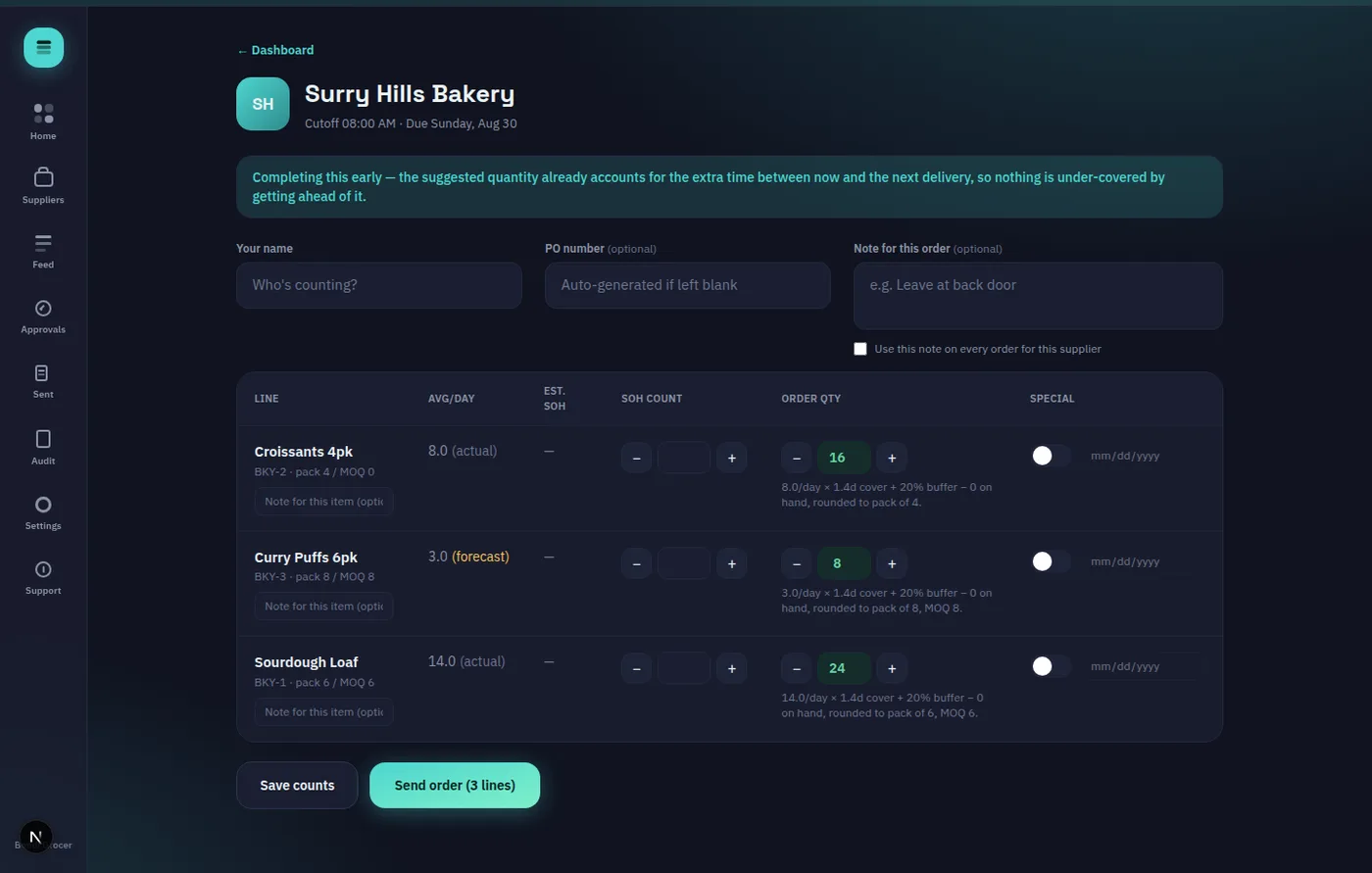 view is a fairly direct digital descendant of the clipboard it replaces. The underlying philosophy is covered in more depth on the OnHand homepage, for anyone weighing whether this is worth the switch for their own store.
The clipboard isn't wrong, it's just finished
There's nothing embarrassing about having run a store on paper for years — it worked, because it had to. But the reasons it worked (simplicity, no training, no cost) are exactly the reasons a well-designed phone-based alternative now works better, without giving up any of that accessibility. The clipboard isn't being replaced because it failed. It's being replaced because, for the first time, there's finally something built for exactly this job that doesn't ask an independent operator to trade simplicity for capability.