The plain-English version
Cover stock days is just: how many days from right now until the next delivery actually lands. Multiply that by how fast the line sells, subtract what you've already got on the shelf, and that's roughly your order — no spreadsheet formula required, just one number and one multiplication.
Cover stock trips people up because it sounds like it needs a formula. It doesn't. It needs one clear question answered correctly: from today, how many days do I actually need this stock to last?
Why this trips people up in practice
The mistake almost everyone makes isn't the maths — it's counting from the wrong starting point. Say your butcher order is scheduled for Tuesday, due Thursday, but you're getting ahead of a busy weekend and placing it Monday instead. If you calculate cover days based on the scheduled Tuesday-to-Thursday gap, you'll under-order — because you actually need to cover from Monday, not Tuesday. That's an extra day of real demand you forgot to include.
The reverse happens too: file an order a day late, and you need less new stock than the schedule implies, because less real time remains until delivery. Anchoring cover days to "now," not to the scheduled due date, is the one rule that keeps this honest in both directions.
The three numbers you actually need
1. Lead time for the next order, specifically. Not this cycle's lead time — the next one. If your supplier's lead time varies by day (a Friday order over a long weekend might take longer than a Tuesday order), use the lead time for whichever order day is actually next, not whatever you're used to.
2. Days until that next order cycle, counted from right now. If you're ordering exactly on schedule, this matches the usual gap. If you're early or late, this is where that gets captured — see above.
3. Your average daily sales for that specific line. Not a store-wide average, not a rough guess — the actual rate that line moves at, ideally based on recent real consumption, not a number from six months ago.
Add lead time and days-until-next-order together to get your cover days. Multiply cover days by average daily sales, add a small fixed safety buffer, subtract what's currently on the shelf (and anything already ordered but not yet delivered), and round up to a sensible pack size. That's the whole calculation.
A worked example, no spreadsheet involved
Say your average daily sales on a mince line is 8kg a day. Your butcher's lead time on a Thursday order is 2 days, and the next order cycle after today is 3 days away. Cover days = 2 + 3 = 5. Demand over that period = 8kg × 5 = 40kg. You've got 6kg on the shelf right now. Shortfall = 34kg. Add a small buffer — say, one day's worth, 8kg — and you're looking at roughly 42kg, rounded to whatever pack size your supplier sells in.
None of that needed a formula bar. It needed four numbers and two additions and one multiplication, done in your head or on the back of a docket.
Where people get the buffer wrong
A common mistake is applying the safety buffer as a percentage of the whole cover period rather than as a flat, one-day-sized margin. If your buffer scales with cover days, a longer cover period (say, covering a supplier's fortnightly cycle) ends up with a proportionally bigger buffer every single cycle — which silently over-orders more the further out your next delivery is. A buffer sized against roughly one day's normal sales, added once, does the job without compounding into real waste over a longer cover window.
Why this is worth automating, even if the maths is simple
The calculation itself isn't hard. What's hard is doing it correctly, consistently, across dozens of lines, multiple suppliers with different lead times, and orders that don't always go out exactly on schedule — by hand, under time pressure, at the end of a long shift. That's where the errors creep in: not because the maths is complicated, but because nobody has time to redo it properly for every line, every day.
This is exactly the kind of deterministic, checkable arithmetic that's worth having software do for you — not because it's smart, but because it's fast and it does the same simple calculation the same correct way every single time, using the actual lead time for your next order and the actual moment you're placing it, not the scheduled date. On OnHand's walk screen, this number updates live as you type your count, so you see the suggested order — and the reasoning behind it — before you've even finished counting. That reasoning is what feeds directly into the due-today and at-risk states you see across the wider dashboard, not a separate, disconnected number.
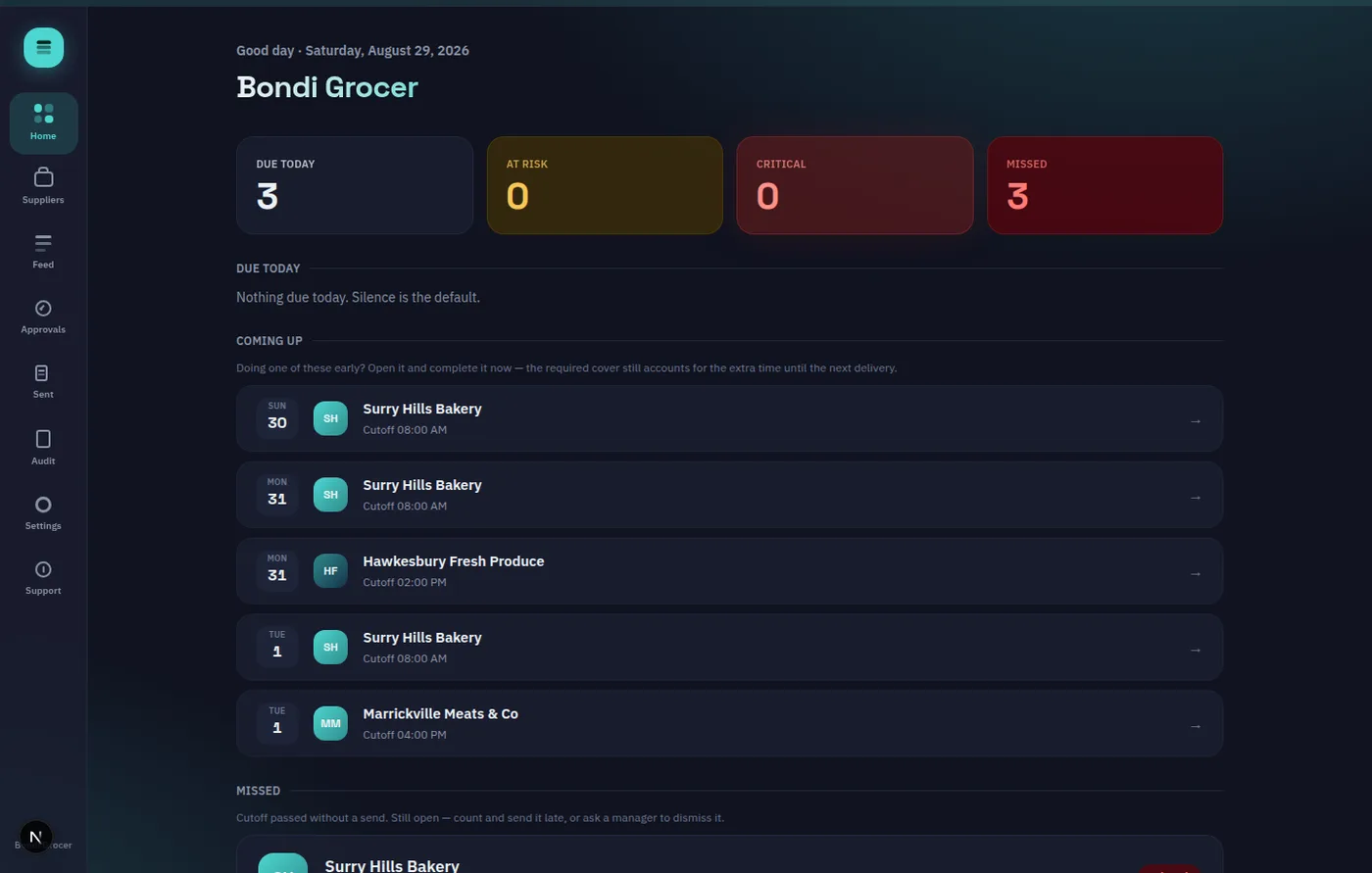
If you want to see the actual arithmetic behind a suggested order, not just the output, the live demo shows the working alongside the suggestion — no signup needed. It's the same maths described above, just done consistently across every line without you having to redo it by hand each time.
Cover stock isn't complicated. It's four honest numbers, added and multiplied correctly, starting from today — not from a schedule that may have already shifted.