Talk to enough independent supermarket operators and a pattern starts to emerge among the ones consistently running tighter margins than their peers. It's rarely one dramatic strategic decision. It's usually a handful of unglamorous, disciplined supply chain habits, practiced consistently, that compound into a meaningfully more profitable operation over time.
1. Ordering from data, not memory or habit
The single most consistent difference between higher- and lower-performing independent supermarkets is what actually drives the order quantity for each product. Lower-performing stores tend to order roughly what was ordered last cycle, adjusted by feel. Higher-performing ones ground each order in an actual observed sales rate — how much of a given product has genuinely been consumed since the last count, projected forward over however many days the next order needs to cover. This single habit directly reduces both major ordering failure modes: overstock that ties up cash and drives wastage, and stockouts that quietly lose sales.
2. Treating every stock count as data worth keeping
The most profitable independent supermarkets don't treat a stock count as a disposable task that exists only to place today's order — they treat each count as a data point that improves tomorrow's accuracy too. Comparing a new count against the last one, accounting for what was received in between, reveals real consumption over a real time period. Stores that retain and use this information get measurably better at ordering over time. Stores that discard each count after use are stuck re-guessing from scratch, indefinitely, no matter how many years they've been in business.
3. Respecting supplier-specific schedules precisely, not approximately
Independent supermarkets juggling several suppliers, each with its own cutoff time, order day, and delivery cadence — some weekly, some fortnightly or monthly — tend to fall into one of two camps: those tracking this precisely, and those approximating it from memory. The approximating camp misses cutoffs more often than they'd like to admit, usually attributing it to a busy week rather than recognizing it as a structural gap in their process. The precise camp treats each supplier's schedule as fixed, checkable data rather than something to remember, and misses far fewer cutoffs as a direct result.
4. Keeping alerts rare, so the ones that matter actually get noticed
This one is counterintuitive, but it shows up consistently among well-run operations: the best supply chain processes aren't the noisiest ones. A system — or a habit — that flags every single order, every single day, trains whoever's watching to tune it out entirely, the same way constant notifications on a phone eventually get ignored altogether. The more disciplined stores build their process so that a normal, on-track order produces no alert at all, and genuine attention is reserved for orders that are actually at risk, critical, or already missed. That restraint is precisely what keeps those rarer alerts meaningful when they do fire.
5. Keeping a real record of who did what, and when
The most profitable independent supermarkets tend to have an answer, without having to guess, to questions like "did we actually send that order" or "who approved this large purchase." That answer comes from keeping a genuine record — of every count, every send, every approval and rejection — rather than relying on anyone's memory of what happened. This habit pays off in disputes with suppliers, in onboarding new staff, and simply in the confidence an owner has that they understand what's actually happening in their own store, rather than trusting that things are probably fine.
Why these habits are hard to sustain manually
None of these five habits are individually complicated. What's genuinely difficult is sustaining all five, consistently, week after week, using nothing but manual effort and personal discipline — especially in a small operation where the same few people are also running the register, managing staff, and handling everything else a store demands. This is exactly the gap purpose-built ordering tools are meant to close: not by replacing an operator's judgment, but by making these habits close to automatic instead of something that has to be actively remembered and maintained by hand every single cycle.
OnHand was built directly around these five patterns — a suggested order quantity grounded in real, continuously-updated sales data; supplier schedules computed precisely against the store's own timezone; alerts that stay silent until something genuinely needs attention; and a full audit trail of every action taken. The overall approach is laid out on OnHand's own site, and the 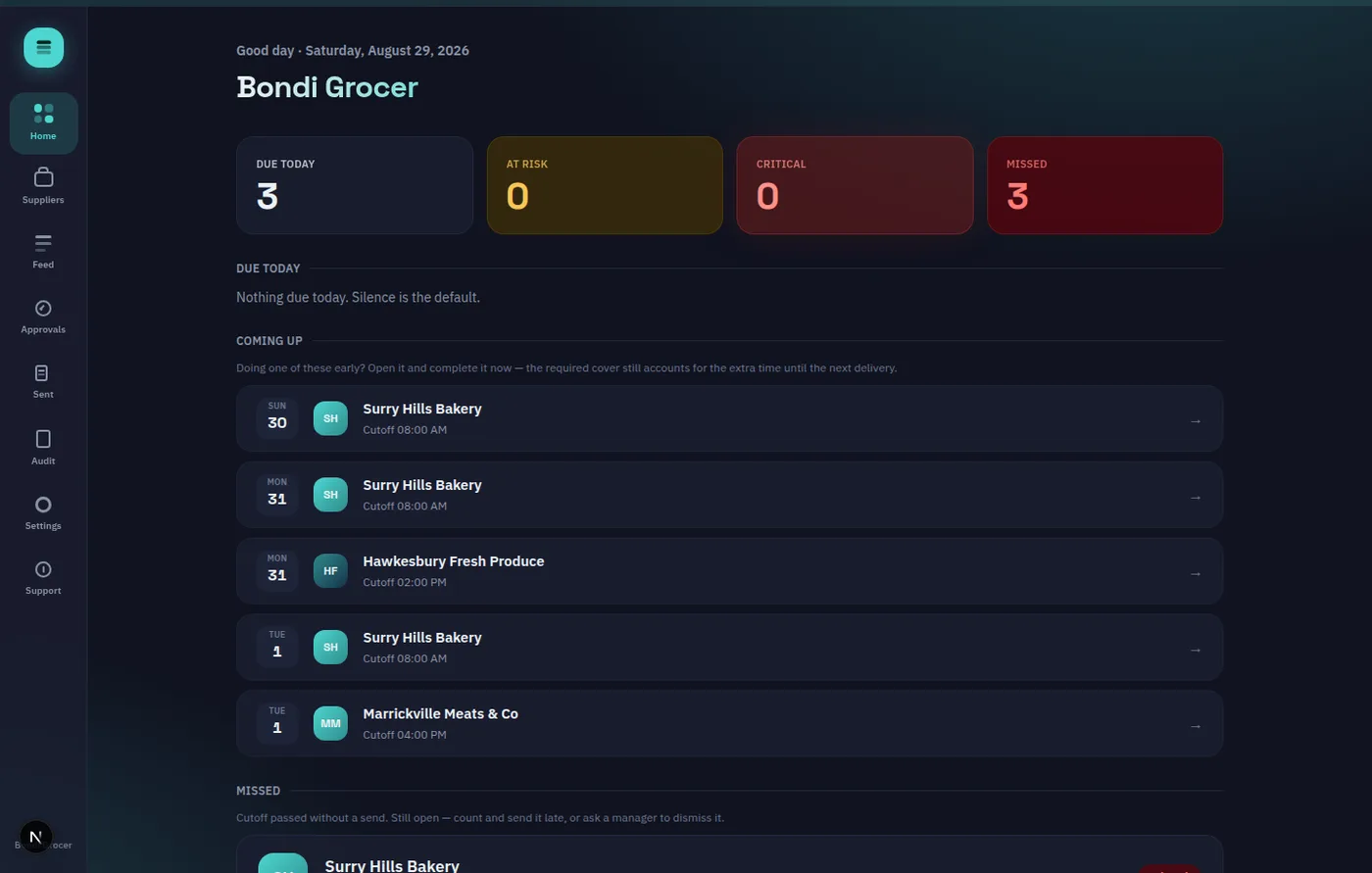 view is a fairly direct picture of what practicing all five habits at once actually looks like day to day. Anyone curious can try the whole flow through the interactive OnHand demo without creating an account.
Discipline, not complexity
None of the operators running the tightest supply chains in independent grocery got there through some secret strategic insight unavailable to everyone else. They got there by consistently practicing a small set of genuinely simple habits that are easy to describe and easy to skip under pressure. The businesses that build systems making those habits close to effortless tend to be the ones that sustain them — and, over time, the ones that end up meaningfully more profitable for it.